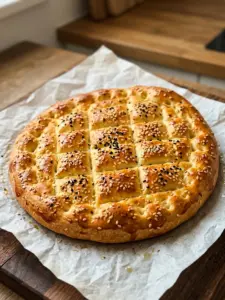

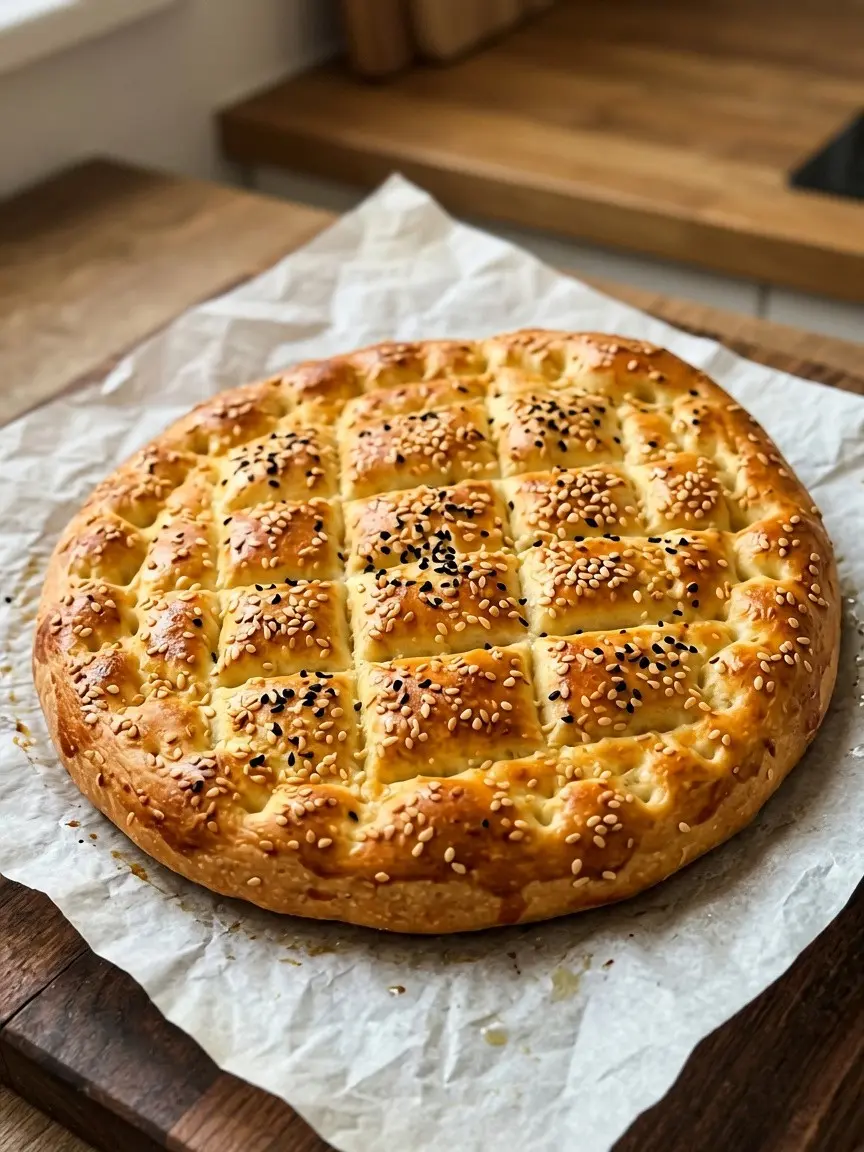
Homemade Turkish pide is a soft, golden flatbread with a pillowy inside, a shiny egg-and-yogurt crust and a signature diamond pattern pressed into the top. A scatter of sesame and nigella seeds finishes it. It looks like something from a Turkish bakery, yet the dough is simple: a handful of pantry ingredients, a soft sticky dough that comes together quickly, and a long, easy rise that does most of the work for you.
This version is almost no-knead. You whisk the dry ingredients, stir in olive oil, milk and water, and let the dough double. Then you divide it in two, pat each piece into a round or oval, press in the border and diamond pattern with your fingertips, brush with the egg wash, sprinkle on the seeds and bake at 400°F (200°C) for 20 to 25 minutes. Let the loaves rest for a few minutes, then tear or slice and serve.
Why You’ll Love This Homemade Turkish Pide
- Almost no kneading. The recipe says the dough traditionally needs no kneading, and a brief 1 to 2 minute knead is optional.
- Simple ingredients. Flour, salt, sugar, yeast, milk, olive oil, water, plus an egg and a spoonful of yogurt for the wash.
- Soft inside, golden outside. The egg and yogurt wash gives a glossy, deep golden top.
- A beautiful pattern. The border and diamond indents make it look impressive, and you only need your fingertips.
- Makes two loaves. One for now and one to share.
- Great for dipping and sharing. Tear it up and serve it with your favorite dips and spreads.
What Does Turkish Pide Taste Like?
Pide has a mild, slightly rich, bready flavor, with a soft, fluffy crumb that is a little chewy. The olive oil and milk make it tender, and the sesame and nigella seeds add a toasty, slightly peppery crunch to the top. Warm from the oven, the crust is glossy and golden, and the indents give you crisp edges and soft pockets all in the same bite.
Ingredients
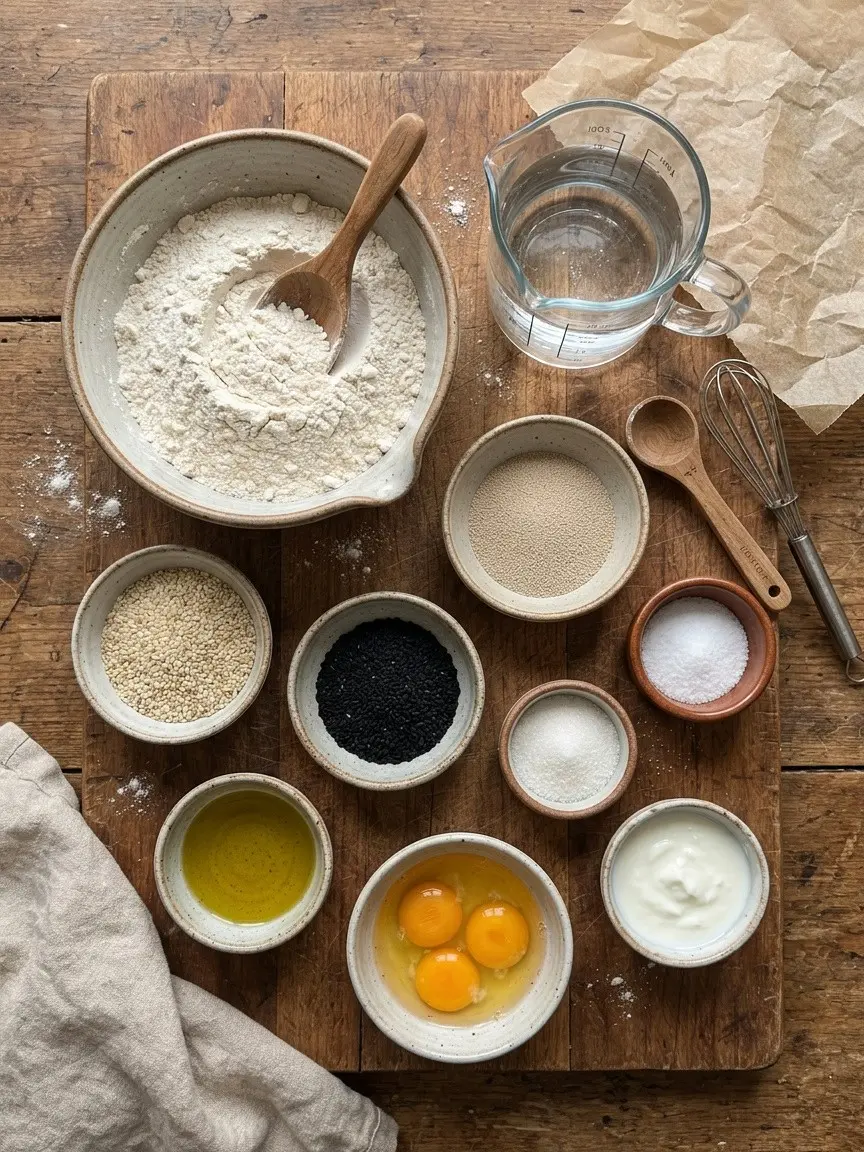
For the dough
- 3 1/4 cups all-purpose flour
- 1 teaspoon sea salt
- 1 teaspoon sugar
- 2 teaspoons dried active yeast
- 1 cup milk, lukewarm
- 4 tablespoons olive oil
- 1/4 cup water, lukewarm
For the egg wash
- 1 tablespoon yogurt
- 1 egg
For the topping
- Sesame seeds and nigella seeds
Ingredient Notes
All-purpose flour
Three and a quarter cups of all-purpose flour make a soft, sticky dough. The recipe stresses not to add too much extra flour, because the dough is meant to be sticky.
Dried active yeast
Two teaspoons are whisked straight into the flour. The milk and water need to be lukewarm, ideally around 105°F (40°C), to help the yeast bloom.
Milk, water and olive oil
One cup of lukewarm milk, 1/4 cup of lukewarm water and 4 tablespoons of olive oil are mixed into the dry ingredients. The milk and oil give a tender, soft crumb.
Salt and sugar
One teaspoon of sea salt seasons the dough, and one teaspoon of sugar helps feed the yeast.
Egg and yogurt wash
One egg and one tablespoon of yogurt are mixed together and brushed all over the dough before baking. This gives the bread its shiny, golden color.
Sesame and nigella seeds
The recipe tops the dough with sesame seeds and nigella seeds, with no amounts given, so sprinkle to your taste. Nigella seeds, also called black seed or black cumin, have a mild, slightly peppery flavor.
Equipment
- A large mixing bowl and a whisk
- A spatula, or clean hands, for mixing the dough
- A lightly greased bowl for rising
- A baking tray and parchment paper
- A pastry brush and a small bowl for the egg wash
- A floured work surface
A Note About This Recipe
The recipe we were given lists the ingredients, the method, helpful notes and nutrition for 1 serving. It gives the rise time, oven temperature, bake time and rest time, but it does not give a prep time or a total time, how many slices each loaf makes, or any storage or freezing guidance. The prep and total times in the recipe card are our own estimates. The nutrition values are from the source, but the serving size is not defined, so treat them as a guide.
Step-by-Step Instructions
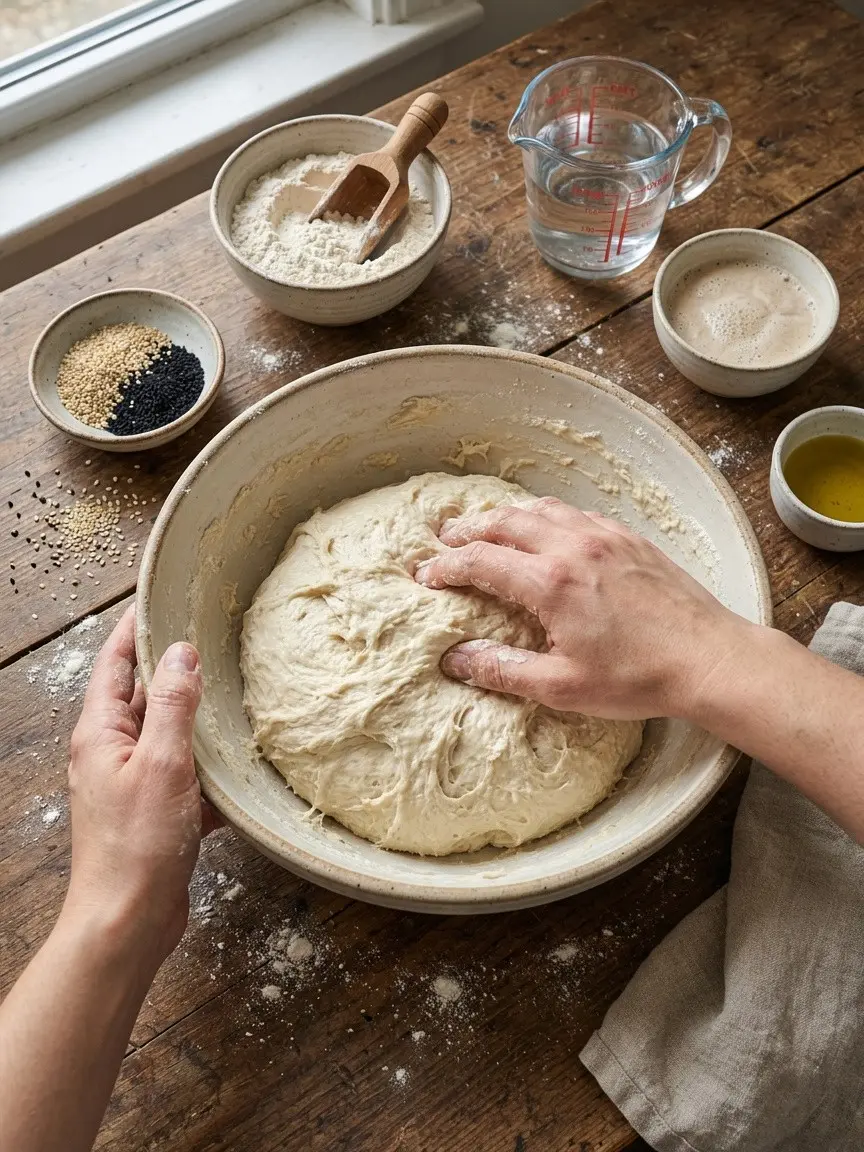
Make the dough
- In a large bowl, whisk together the flour, salt, sugar and yeast.
- Mix in the olive oil, milk and water.
- Combine into a dough with your hands or a spatula. It is a soft, sticky dough that comes together quickly. If you like, knead briefly for 1 to 2 minutes. This is optional, as the dough traditionally does not need kneading.
- Transfer the dough to a lightly greased bowl. Cover and keep in a draft-free place for 1 to 1 1/2 hours, or until the dough doubles in size.
Shape the pide
- Preheat the oven to 400°F (200°C). Line a baking tray with parchment paper.
- Turn the dough out onto a lightly floured surface and gently deflate it.
- Divide it into 2 equal portions. Starting with one portion, gently pat it into a circle or oval about 7 to 8 inches in diameter and place it on the prepared tray.
- With your fingertips, indent a border about 1 inch inside the edge of the dough, all around. Then make the characteristic diamond pattern by making indents along the dough vertically and then horizontally. Repeat with the remaining dough.
Add the egg wash and bake
- Make the egg wash by mixing the egg and yogurt together in a small bowl. Brush it all over the dough.
- Sprinkle the seeds on top and bake at 400°F (200°C) for 20 to 25 minutes, until the bread is golden on top.
- Remove from the oven and let the loaves rest for 5 to 10 minutes before slicing and serving. Enjoy.
Tips for the Best Turkish Pide
- Keep the liquids lukewarm. Around 105°F (40°C) wakes up the yeast without killing it.
- Embrace the sticky dough. It is supposed to be soft and sticky, so resist adding lots of extra flour.
- Knead briefly if you like. One to two minutes is optional, but the dough works without it.
- Be patient with the rise. Colder rooms take longer, so wait until the dough has doubled.
- Use a draft-free spot. It helps the dough rise evenly.
- Go deep with the indents. The bread puffs as it bakes, and shallow indents will vanish.
- Rest the dough if it springs back. Give it 5 to 10 minutes, then try again.
- Brush the wash all over. This gives an even, golden crust.
- Let it rest after baking. Five to 10 minutes makes slicing easier.
Variations
The recipe uses sesame and nigella seeds. These other ideas are our own suggestions and are untested:
- Use only sesame seeds if you do not have nigella seeds.
- Brush the baked bread with a little olive oil for extra softness.
- Serve with a dipping oil, or with herbed butter.
Substitutions
- Nigella seeds: the recipe lists sesame seeds and nigella seeds together. If you only have sesame, use that, but we have not tested it.
- Milk: the recipe uses lukewarm milk. We have not tested non-dairy milks.
- Yogurt: the recipe mixes yogurt with the egg for the wash.
- Dried active yeast: the recipe uses dried active yeast, and we have not tested other types.
Serving Suggestions
Serve the pide warm, torn or sliced, as a side with soups, stews and salads, or as part of a mezze-style spread with dips, olives and cheese. It is also lovely at breakfast with butter and jam, or alongside eggs. If you like homemade bread, you might also enjoy our 5-Minute Bread and Traditional German Brezels.
Storage
The recipe source does not give storage guidance. As general advice, keep leftover bread wrapped or in an airtight container at room temperature for a day or so, and warm it briefly in the oven before serving to refresh the crust. We have not tested how long it keeps.
Freezing
The recipe source does not cover freezing, and we have not tested it.
Common Mistakes to Avoid
- Using hot milk or water. It can kill the yeast. Keep it lukewarm.
- Adding too much flour. The dough should stay soft and sticky.
- Cutting the rise short. The dough needs to double in size.
- Shallow indents. The pattern will disappear as the bread rises in the oven.
- Skipping the egg wash. The bread will lack its golden color and shine.
- Cutting it too soon. Let it rest 5 to 10 minutes after baking.
Frequently Asked Questions
Is this a no-knead bread?
Yes. The recipe says it traditionally needs no kneading. You can knead briefly for 1 to 2 minutes if you like, but you can skip it.
Why is my dough so sticky?
It is supposed to be. The recipe says the dough should be soft and sticky, so do not add too much extra flour.
How long does the dough need to rise?
One to one and a half hours, or until doubled. It depends on room temperature, so colder rooms take longer.
Why do my indents spring back?
Let the dough rest for 5 to 10 minutes, then try again.
Why did my diamond pattern disappear?
The indents were probably too shallow. Because the bread rises as it bakes, press deeply.
What temperature do I bake it at?
400°F (200°C) for 20 to 25 minutes, until golden on top.
How many loaves does this make?
Two. The dough is divided into 2 equal portions.
What are nigella seeds?
Small black seeds with a mild, slightly peppery flavor, often sprinkled on Turkish and Middle Eastern breads.
How many calories are in a serving?
The source lists 113 calories per serving, but does not say how large a serving is.
Recipe Background
Pide is a Turkish flatbread with many forms. The round or oval loaf with a pressed diamond pattern, egg wash and sesame seeds is a familiar sight in Turkish bakeries, especially during Ramadan, when it is traditionally baked fresh. Pide is also the name of a boat-shaped Turkish pastry with toppings, but this recipe is the soft, plain bread.
This recipe is adapted from the Homemade Turkish Pide recipe provided to us, written here in our own words with the same ingredients, amounts and method.
Share Your Creation
Did you make this homemade Turkish pide? Leave a comment below and tell us how it turned out. How deep did you make your diamond pattern, and what did you serve it with? Your tips help other readers.
Conclusion
Homemade Turkish pide is a rewarding bread that does most of the work itself. Whisk the dry ingredients, mix in the wet, let the sticky dough double, press the diamond pattern deeply into two rounds, brush with egg and yogurt, add the seeds and bake until golden. Rest it for a few minutes, then tear it up and enjoy it warm.
More Delicious Recipes You’ll Love
- 5-Minute Bread (Soft, Fluffy & Shockingly Easy)
- Shockingly Easy 5-Ingredient Soft Cornstarch Bread
- Traditional German Brezels (Laugenbrezel)
- Soft Buttery Dinner Rolls
- Soft & Irresistible Condensed Milk Bread Rolls
Follow Poulef on Pinterest
Loved this recipe? Save it for later and follow @PoulefRecipe on Pinterest for more homemade bread and baking ideas: https://www.pinterest.com/poulefrecipe/
Nutritional Information
Nutrition values are from the recipe provided, for 1 serving. The source does not say how large a serving is, so treat these as a guide.
| Nutrient | Amount per Serving |
|---|---|
| Calories | 113 |
| Carbohydrates | 17g |
| Protein | 3g |
| Fat | 4g |
| Saturated Fat | 1g |
| Cholesterol | 10mg |
| Sodium | 125mg |
| Fiber | 1g |
| Sugar | 1g |
Homemade Turkish Pide (Easy No-Knead Flatbread)
- Total Time: 2 hours 10 minutes
- Yield: 2 flatbreads 1x
Description
Soft, fluffy Turkish flatbread made from an easy, almost no-knead dough, pressed with the traditional diamond pattern, brushed with egg and yogurt and topped with sesame and nigella seeds.
Ingredients
3 1/4 cups all-purpose flour
1 teaspoon sea salt
1 teaspoon sugar
2 teaspoons dried active yeast
1 cup milk, lukewarm
4 tablespoons olive oil
1/4 cup water, lukewarm
For the egg wash: 1 tablespoon yogurt
For the egg wash: 1 egg
For the topping: sesame seeds and nigella seeds
Instructions
1. In a large bowl, whisk together the flour, salt, sugar and yeast.
2. Mix in the olive oil, milk and water.
3. Combine into a dough with your hands or a spatula. It is a soft, sticky dough that comes together quickly. If you like, knead briefly for 1 to 2 minutes. This is optional, as the dough traditionally does not need kneading.
4. Transfer the dough to a lightly greased bowl. Cover and keep in a draft-free place for 1 to 1 1/2 hours, or until the dough doubles in size.
5. Preheat the oven to 400°F (200°C). Line a baking tray with parchment paper.
6. Turn the dough out onto a lightly floured surface and gently deflate it.
7. Divide it into 2 equal portions. Starting with one portion, gently pat it into a circle or oval about 7 to 8 inches in diameter and place it on the prepared tray.
8. With your fingertips, indent a border about 1 inch inside the edge of the dough, all around. Then make the characteristic diamond pattern by making indents along the dough vertically and then horizontally. Repeat with the remaining dough.
9. Make the egg wash by mixing the egg and yogurt together in a small bowl. Brush it all over the dough.
10. Sprinkle the seeds on top and bake at 400°F (200°C) for 20 to 25 minutes, until the bread is golden on top.
11. Remove from the oven and let the loaves rest for 5 to 10 minutes before slicing and serving.
Notes
Adapted from the Homemade Turkish Pide recipe provided, rewritten in our own words with the same ingredients, amounts and method.
The milk and water need to be lukewarm to help the yeast bloom. The ideal temperature is around 105°F (40°C).
This is a no-knead bread, but kneading briefly for 1 to 2 minutes is optional.
The dough is supposed to be soft and sticky. Do not add too much extra flour.
Proofing time depends on the ambient temperature. The colder it is, the longer it needs, so let the yeast do its job.
If the dough springs back when you make the indents, let it rest for 5 to 10 minutes and try again.
Make the indentations deep, because the flatbread rises as it bakes. If the pattern is too shallow, it will disappear in the oven.
The source gave no prep time, total time, storage or freezing guidance. The prep and total times shown are our own estimates, apart from the 1 to 1 1/2 hour rise, the 20 to 25 minute bake and the 5 to 10 minute rest, which are from the source.
Nutrition is from the source, for 1 serving. The source does not say how large a serving is.
- Prep Time: 15 minutes
- Cook Time: 25 minutes
- Category: Bread
- Method: Baking
- Cuisine: Turkish
Nutrition
- Serving Size: 1 serving
- Calories: 113
- Sugar: 1g
- Sodium: 125mg
- Fat: 4g
- Saturated Fat: 1g
- Carbohydrates: 17g
- Fiber: 1g
- Protein: 3g
- Cholesterol: 10mg
Table of Contents

Gianna Poulef
I’m Gianna Poulef from Poulef Recipes. I love sharing perfected dishes from my kitchen. I’m sure they’ll earn a spot in your heart. Let’s savor this journey together!.
Let’s be friends!