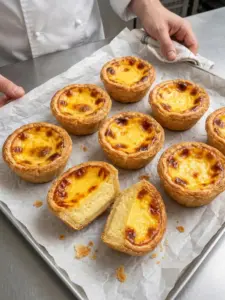

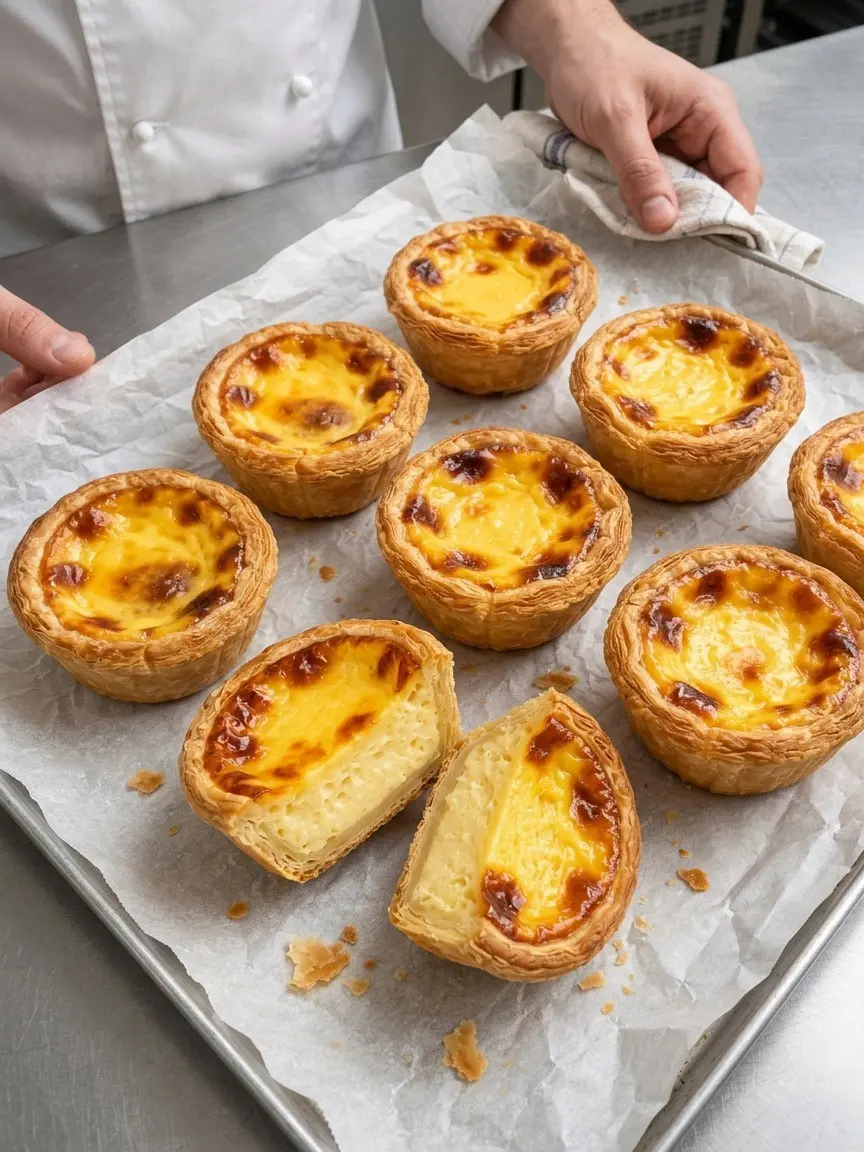
These homemade Portuguese egg tarts are small, glossy custard tarts with a shatteringly flaky pastry shell and a silky, cinnamon-scented yolk filling. The custard bakes at very high heat, so the tops blister and blacken in spots, which is exactly how a good Portuguese egg tart should look. A final dusting of cinnamon and a warm serving temperature make them very hard to resist.
This recipe is a project. Instead of using store-bought puff pastry, you roll and laminate your own dough with softened butter, shape it into a tight log, chill it and cut it into spiral slices. Each slice is pressed into a mold to make a layered, crisp shell. The recipe makes 30 small tarts, so it is a good choice for a party, a holiday or any day when you feel like baking something special. It needs a few hours of chilling, so plan ahead.
Why You’ll Love These Portuguese Egg Tarts
- Flaky spiral pastry. Rolling the butter into the dough and slicing the log gives layers of crisp pastry.
- Silky custard. A cooked, strained custard of milk, flour, sugar syrup and egg yolks is smooth and rich.
- Cinnamon aroma. A cinnamon stick flavors the syrup, and ground cinnamon finishes the tarts.
- Blistered tops. The very hot oven gives a golden, caramelized, blackened-in-spots finish.
- Makes 30. Plenty to share.
- Make-ahead dough. The pastry log can chill overnight.
What Do They Taste Like?
The shell is crisp, buttery and flaky, with fine layers that crackle when you bite into them. The custard is soft and creamy, sweet but not heavy, with a warm hint of cinnamon from the syrup. The burnt spots on the surface add a slight caramel bitterness that balances the sweetness. They are best eaten warm, when the pastry is at its crispest and the custard is just set.
Ingredients
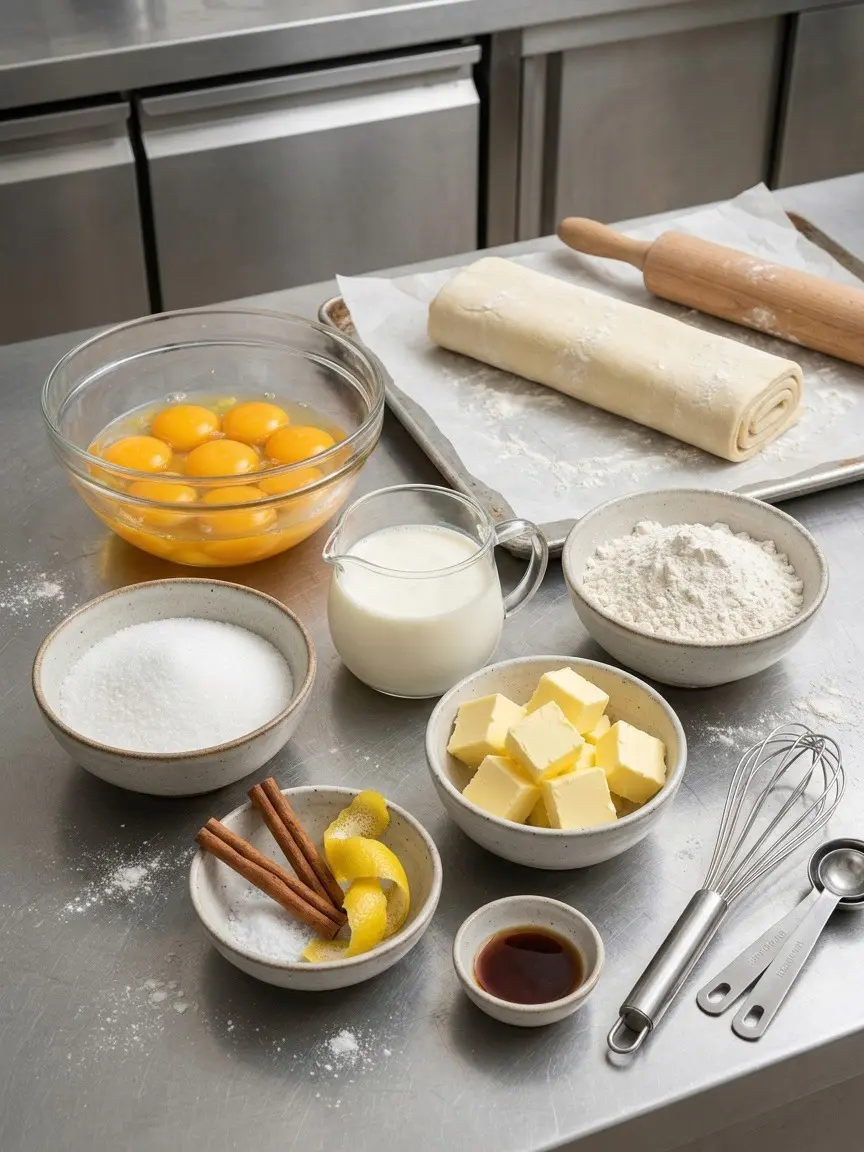
For the puff pastry
- 1 1/2 sticks unsalted butter, softened
- 1 3/4 cups all-purpose flour, plus more for dusting
- 2/3 cup water
- 1/4 teaspoon kosher salt
For the filling and garnish
- 1 cup granulated sugar
- 2/3 cup water
- 1 cinnamon stick
- 1 cup plus 6 tablespoons whole milk, divided
- 1/2 cup all-purpose flour
- 6 egg yolks
- Ground cinnamon, for garnish
Special equipment
- Egg tart molds (or a muffin tin)
Ingredient Notes
Butter
One and a half sticks of unsalted butter are used for the laminated dough, which is 6 ounces. The butter is whisked until it is the consistency of sour cream, so that it spreads easily without tearing the dough. Soften it first, but do not let it turn oily.
Flour
The pastry uses 1 3/4 cups of all-purpose flour, plus extra for dusting. The custard uses another 1/2 cup, which thickens it into a pastry cream-like base.
Water and salt
Two-thirds of a cup of water and a quarter teaspoon of kosher salt bring the dough together. There is no butter in the dough itself, so it starts out tacky and lean.
Sugar, water and cinnamon stick
A syrup of 1 cup of sugar and 2/3 cup of water, simmered for a minute with a cinnamon stick, sweetens and flavors the custard. Remove the cinnamon stick before you whisk the syrup into the milk.
Whole milk
You need 1 cup plus 6 tablespoons of whole milk in total. Part of it is heated, and part is whisked with the flour. Whole milk gives the custard its richness.
Egg yolks
Six yolks enrich the custard. They are whisked into the thickened mixture off the heat, then strained to keep the custard perfectly smooth.
Ground cinnamon
A light dusting over the warm tarts adds aroma at serving time.
Equipment
- A stand mixer with a dough hook
- A rolling pin and a bench scraper
- Plastic wrap
- Egg tart molds, or a standard muffin tin
- Two saucepans
- A whisk and a fine-mesh sieve
- Wire racks for cooling
A Note About This Recipe
The recipe we were given lists the ingredients, a detailed method, the chilling and baking times, the oven temperature, nutrition and the yield (the dough is cut into 30 slices). It does not give a prep time or a total time, so those are our own estimates. It also lists the oven temperature as 500° without units, which we take to mean 500°F. The nutrition is listed per serving without saying how many tarts that is, so we show it per tart as an approximation.
Step-by-Step Instructions
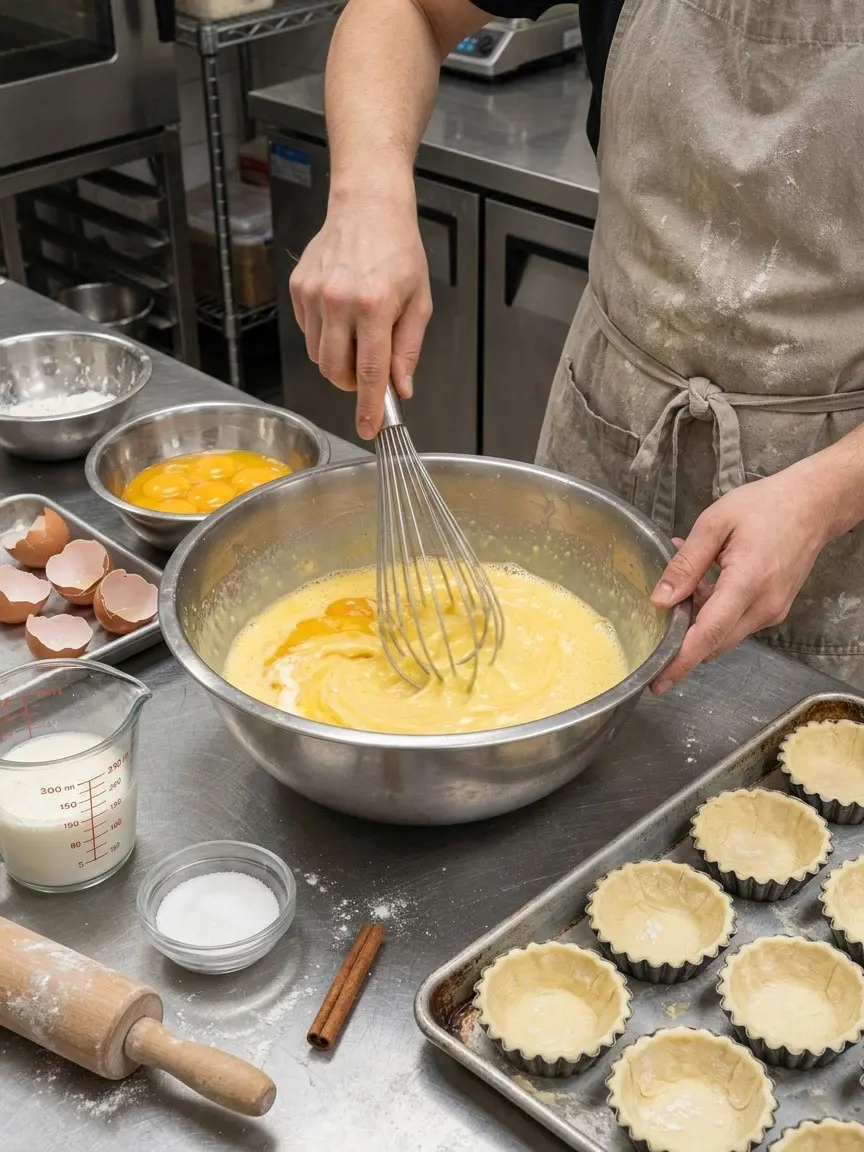
Make the pastry dough
- In a small bowl, whisk the softened butter until it is the consistency of sour cream.
- In the bowl of a stand mixer fitted with the dough hook, combine the flour, water and salt. Mix on low speed, scraping the bowl down occasionally, until the mixture comes together and has a tacky consistency.
- Transfer the dough to a well-floured work surface and form it into a 1-inch-thick rectangle. With a floured rolling pin, roll it into a 1/2-inch-thick rectangle, 10 inches long. Cover with plastic wrap and let it rest for 15 minutes.
Laminate the dough
- Remove the plastic wrap and roll the dough into a 15-inch square, dusting with more flour as needed.
- Spread a third of the butter on the bottom half of the dough, leaving a 1-inch rim. Using a bench scraper, fold the top half of the dough over the butter. Press the edges to seal and pat the dough with the rolling pin.
- Roll the dough into another 15-inch square. Spread half of the remaining butter on the bottom half, leaving a 1-inch rim. Fold the top half over, press the edges to seal and pat the dough.
- Rotate the dough so that the seam faces you, then roll it into an 18-inch square.
- Spread the remaining butter over the whole dough, leaving a 1-inch rim. Starting with the edge closest to you, roll the dough into a tight log. Wrap it in plastic wrap and refrigerate until very firm, at least 2 hours and preferably overnight.
Make the syrup and shape the shells
- Preheat the oven to 500°F. In a medium saucepan over high heat, combine the sugar, 2/3 cup of water and the cinnamon stick. Bring to a boil and cook for 1 minute, then remove from the heat and let sit until you need it.
- On a lightly floured surface, trim the ends of the dough log so they are even, then cut the log into thirty 1/2-inch slices.
- Place each slice, with the cut side of the spiral facing up, into a cavity of an egg tart mold or a muffin tin. Use your thumb to press the center of the spiral into the bottom, and keep pressing to flatten the dough evenly against the bottom and sides. It should extend about 1/16 inch above the rim of a tart mold, or 3/4 inch up the sides of a muffin tin.
- Repeat with the remaining slices. Refrigerate until firm, about 10 minutes.
Make the custard and bake
- Meanwhile, heat 1 cup plus 1 tablespoon of the milk in a small saucepan over medium heat until bubbles begin to form around the edges, 4 to 5 minutes.
- In a large bowl, whisk the flour with the remaining 5 tablespoons of milk. Continue whisking while adding the hot milk in a slow, steady stream.
- Discard the cinnamon stick from the syrup and whisk the syrup into the milk mixture in a steady stream. Return the mixture to the saucepan and cook over low heat, whisking constantly, until thickened, 10 to 12 minutes.
- Add the egg yolks and whisk until well combined, then strain through a fine-mesh sieve.
- Pour 1 1/2 tablespoons of the warm filling into each pastry shell.
- Bake for 15 to 20 minutes, until the shells are golden brown and crisp, the custards are set and the tops are blackened in spots.
- Let the tarts cool in the pans on wire racks for 5 minutes. Remove the molds, transfer the tarts to the racks and sprinkle with cinnamon. Serve warm.
Tips for the Best Egg Tarts
- Whisk the butter to sour cream consistency. It spreads more evenly and keeps the layers intact.
- Flour your surface well. The dough is tacky at first.
- Roll the log tightly. A tight spiral gives neat, even layers in each shell.
- Chill the log until very firm. At least 2 hours, or overnight, makes it easy to cut clean slices.
- Press the dough evenly into the molds. Thin, even shells bake crisp.
- Whisk constantly while the custard thickens. It prevents lumps and scorching.
- Strain the custard. It guarantees a silky texture.
- Do not be afraid of the dark spots. The blackened patches on top are a signature of the tart.
- Serve them warm. The pastry is crispest right after baking.
Variations
The recipe is complete as written. If you want to experiment, these are suggestions that are not part of the original:
- Muffin tin (from the recipe). If you do not have egg tart molds, use a standard muffin tin.
- Dust with a little powdered sugar as well as cinnamon.
- Make half the dough ahead, since the log keeps in the refrigerator overnight.
Substitutions
- Egg tart molds: a muffin tin is the suggested alternative.
- Cinnamon stick: used to flavor the syrup, and removed before mixing.
- Whole milk: the recipe is written with whole milk.
- Homemade pastry: we have not tested store-bought puff pastry in this recipe.
Serving Suggestions
Serve the tarts warm, with a sprinkle of cinnamon, on a platter. They go well with:
- A cup of strong coffee or espresso
- Hot tea
- A holiday dessert table
- An afternoon gathering or party
For more custard and pastry desserts, see the related recipes at the end of this article.
Storage
The recipe source does not give storage guidance. As general advice, these tarts are best eaten the day they are made. Because the filling contains eggs and milk, refrigerate any leftovers in a covered container.
Freezing
The recipe source does not cover freezing, and we have not tested it. The unbaked pastry log is described only as chilling in the refrigerator, at least 2 hours and preferably overnight.
Common Mistakes to Avoid
- Not chilling the log long enough. It will be too soft to cut into neat slices.
- Letting the butter get oily. It leaks out of the dough instead of forming layers.
- Pressing the shells unevenly. Thick spots stay doughy.
- Skipping the straining. The custard may contain lumps or bits of cooked egg.
- Stopping the whisking. The custard scorches or turns lumpy.
- Underbaking. The shells should be golden brown and the custards set.
- Overfilling the shells. The recipe uses 1 1/2 tablespoons each.
Frequently Asked Questions
How many tarts does this make?
The dough log is cut into 30 slices, so the recipe makes 30 small tarts.
How long does the dough need to chill?
At least 2 hours, and preferably overnight, until very firm.
What temperature do I bake them at?
The source says 500°, which we take to mean 500°F. Bake for 15 to 20 minutes.
What do the dark spots on top mean?
The very hot oven blackens the custard in spots. The recipe says the tops should be blackened in spots when the tarts are done.
Can I use a muffin tin?
Yes. The recipe suggests a muffin tin if you do not have egg tart molds, and the dough should extend about 3/4 inch up the sides.
Why strain the custard?
Straining through a fine-mesh sieve removes any lumps and gives a perfectly smooth filling.
Can I make the dough ahead?
Yes. The recipe says the log can chill in the refrigerator overnight.
Should I serve them warm?
Yes. The recipe says to serve them warm, with a sprinkle of cinnamon.
How many calories are in a tart?
The source lists 110 calories per serving, along with 5.4 g of fat, 14.1 g of carbohydrates and 1.5 g of protein. It does not say how many tarts make a serving, so we show it per tart.
Recipe Background
Portuguese egg tarts, known in Portugal as pastéis de nata, are small custard tarts with a crisp laminated pastry shell, traditionally baked at a very high temperature so that the custard caramelizes and blisters. They are popular in bakeries and cafés and have spread widely around the world. This version makes the pastry by hand, rolling butter into a simple dough and slicing the rolled log into spiral discs, and flavors the custard with a cinnamon-scented sugar syrup.
This recipe is adapted from the Portuguese egg tart recipe on Tasting Table, written here in our own words with the same ingredients, amounts and method.
Share Your Creation
Did you make these Portuguese egg tarts? Leave a comment below and tell us how they turned out. Did you use egg tart molds or a muffin tin? Did you chill the dough overnight? Your tips help other readers make the recipe their own.
Conclusion
These homemade Portuguese egg tarts take time, but the reward is a batch of flaky, crisp shells filled with silky cinnamon custard and blistered on top. Make the dough, roll in the butter, chill the log, slice and press the shells, cook the custard, strain it, fill and bake in a very hot oven. Sprinkle with cinnamon and enjoy them warm.
More Delicious Recipes You’ll Love
- Vanilla Custard Puff Pastries
- Creamy Condensed Milk Tart with Golden Caramelized Top – The Irresistible 5-Ingredient Dessert
- Creamy Custard Cake
- Calatrava Bread (Pan de Calatrava)
- Christmas Baby Lemon Impossible Pie
Follow Poulef on Pinterest
Loved this recipe? Save it for later and follow @PoulefRecipe on Pinterest for more pastries and easy desserts: https://www.pinterest.com/poulefrecipe/
Nutritional Information
These are the nutrition values listed by the source recipe per serving. The source does not say how many tarts make a serving, so we show them per tart, which fits the 30-tart yield. Treat them as an approximation, since actual values will vary with the size of your tarts.
| Nutrient | Amount per Serving |
|---|---|
| Calories | 110 |
| Carbohydrates | 14.1g |
| Protein | 1.5g |
| Fat | 5.4g |
| Saturated Fat | 3.2g |
| Trans Fat | 0.2g |
| Cholesterol | 41.4mg |
| Sodium | 18.5mg |
| Fiber | 0.4g |
| Sugar | 6.7g |
Homemade Portuguese Egg Tarts
- Total Time: 4 hours 15 minutes
- Yield: 30 small tarts 1x
Description
Small Portuguese-style egg tarts with a homemade spiral puff pastry shell and a silky cinnamon-scented egg yolk custard, baked at high heat until blistered and dusted with cinnamon.
Ingredients
For the puff pastry: 1 1/2 sticks unsalted butter, softened
1 3/4 cups all-purpose flour, plus more for dusting
2/3 cup water
1/4 teaspoon kosher salt
For the filling: 1 cup granulated sugar
2/3 cup water
1 cinnamon stick
1 cup plus 6 tablespoons whole milk, divided
1/2 cup all-purpose flour
6 egg yolks
Ground cinnamon, for garnish
Special equipment: egg tart molds (or a muffin tin)
Instructions
1. Make the pastry dough: in a small bowl, whisk the butter until it is the consistency of sour cream. In the bowl of a stand mixer fitted with the dough hook, combine the flour, water and salt. Mix on low speed, scraping the bowl down occasionally, until the mixture comes together and is tacky.
2. Transfer the dough to a well-floured surface and shape it into a 1-inch-thick rectangle. With a floured rolling pin, roll it into a 1/2-inch-thick rectangle, 10 inches long. Cover with plastic wrap and rest for 15 minutes.
3. Unwrap the dough and roll it into a 15-inch square, dusting with more flour as needed. Spread one third of the butter on the bottom half, leaving a 1-inch rim. Using a bench scraper, fold the top half over the butter. Press the edges to seal and pat the dough with the rolling pin. Roll into another 15-inch square.
4. Spread half of the remaining butter on the bottom half of the dough, leaving a 1-inch rim. Fold the top half over, press the edges to seal and pat the dough. Rotate the dough so the seam faces you, then roll it into an 18-inch square.
5. Spread the remaining butter all over the dough, leaving a 1-inch rim. Starting with the edge closest to you, roll the dough into a tight log. Wrap in plastic wrap and refrigerate until very firm, at least 2 hours and preferably overnight.
6. Make the syrup: preheat the oven to 500°F. In a medium saucepan over high heat, combine the sugar, 2/3 cup water and the cinnamon stick. Bring to a boil and cook for 1 minute, then remove from the heat and let sit until needed.
7. On a lightly floured surface, trim the ends of the log so they are even, then cut it into thirty 1/2-inch slices. Place each slice, cut side up, in a cavity of an egg tart mold or muffin tin. Use your thumb to press the center of the spiral into the bottom and keep pressing to flatten the dough evenly against the bottom and sides. It should extend about 1/16 inch above the rim of a tart mold, or 3/4 inch up the sides of a muffin tin. Refrigerate until firm, about 10 minutes.
8. Make the custard: heat 1 cup plus 1 tablespoon of the milk in a small saucepan over medium heat until bubbles form around the edges, 4 to 5 minutes. In a large bowl, whisk the 1/2 cup flour with the remaining 5 tablespoons of milk. Whisking constantly, add the hot milk in a slow, steady stream.
9. Remove the cinnamon stick from the syrup and whisk the syrup into the milk mixture in a steady stream. Return to the saucepan and cook over low heat, whisking constantly, until thickened, 10 to 12 minutes.
10. Add the egg yolks and whisk until well combined, then strain through a fine-mesh sieve. Pour 1 1/2 tablespoons of the warm filling into each pastry shell.
11. Bake for 15 to 20 minutes, until the shells are golden brown and crisp, the custards are set and the tops are blackened in spots. Cool in the pans on wire racks for 5 minutes, then remove the molds, transfer the tarts to the racks and sprinkle with cinnamon. Serve warm.
Notes
Adapted from the Portuguese egg tart recipe on Tasting Table, rewritten in our own words with the same ingredients, amounts and method.
This is an advanced recipe with a homemade rolled, laminated pastry. The dough needs to rest at least 2 hours, and preferably overnight.
The source says to bake at 500°, which we have taken to mean 500°F. Egg tarts are traditionally baked at very high heat so that the tops blister and darken in spots.
The source gives nutrition per serving (110 calories) but does not say how many tarts make up a serving. We show it as per tart, which fits the 30-tart yield, but treat it as an approximation.
The source gave no prep time or total time. The prep time and total time are our own estimates, and the 2-hour minimum chill, the 15-minute rest, the 10-minute chill and the 15 to 20 minute bake are from the source.
- Prep Time: 1 hour 30 minutes
- Cook Time: 15 to 20 minutes
- Category: Dessert
- Method: Baking
- Cuisine: Portuguese
Nutrition
- Serving Size: 1 tart
- Calories: 110
- Sugar: 6.7g
- Sodium: 18.5mg
- Fat: 5.4g
- Saturated Fat: 3.2g
- Trans Fat: 0.2g
- Carbohydrates: 14.1g
- Fiber: 0.4g
- Protein: 1.5g
- Cholesterol: 41.4mg
Table of Contents

Gianna Poulef
I’m Gianna Poulef from Poulef Recipes. I love sharing perfected dishes from my kitchen. I’m sure they’ll earn a spot in your heart. Let’s savor this journey together!.
Let’s be friends!