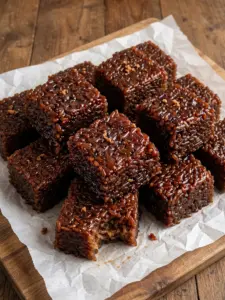

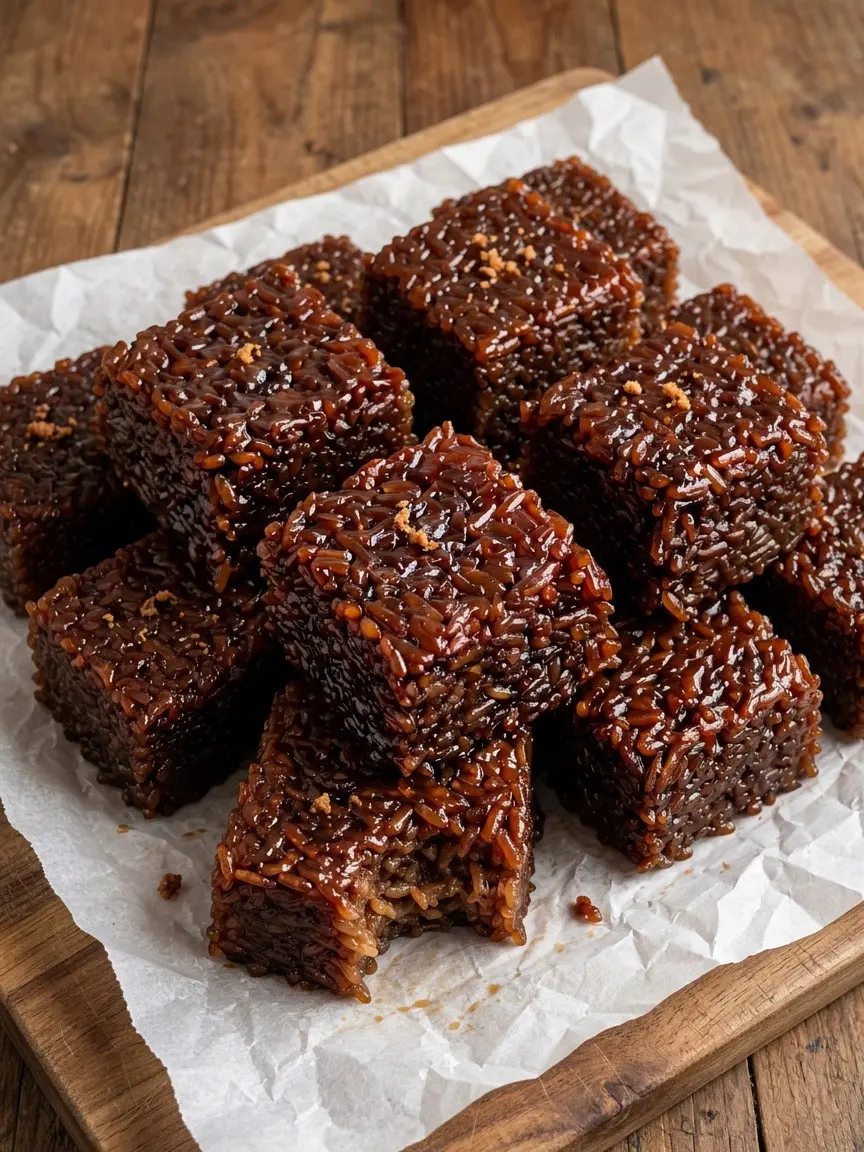
Filipino biko is a sticky rice cake made by cooking glutinous rice with thick coconut milk and brown sugar until it turns dense, glossy and wonderfully chewy. It is pressed into a banana-leaf-lined pan, left to cool, cut into squares and finished with latik, the crisp, caramelized curds left behind when coconut milk is cooked down until its oil separates. The result is sweet, creamy, a little salty and full of coconut flavor.
Biko is a traditional Filipino dessert and snack, and it is simpler than it looks. You cook the rice with a pandan leaf, stir in coconut milk, sugar and salt, and keep cooking until the mixture is thick enough to leave the sides of the pan. While that happens, a second pan turns coconut milk into the toasted curds that crown the top. This version follows a tested recipe closely, and includes the optional coconut caramel topping for anyone who prefers a drizzle over curds.
Why You’ll Love This Filipino Biko
- Chewy and rich. Glutinous rice cooked in coconut milk gives a dense, sticky, satisfying bite.
- Just a handful of ingredients. Glutinous rice, water, pandan, coconut milk, brown sugar and salt make the base.
- Two toppings in one recipe. Crispy latik, or a coconut caramel drizzle if you prefer.
- Made on the stovetop. No oven is needed.
- Easy to cut and share. Once cooled, biko slices into neat squares.
- Adjustable sweetness. The sugar depends on your taste, and the recipe says so.
What Does Biko Taste Like?
Biko tastes of brown sugar, coconut and a hint of pandan. The rice is soft but chewy and holds together in a sticky, almost toffee-like mass. A little salt keeps the sweetness in check. The latik on top adds a crisp, nutty, caramelized contrast to the soft rice, and the oil that separates out during cooking is a bonus you can save.
Ingredients
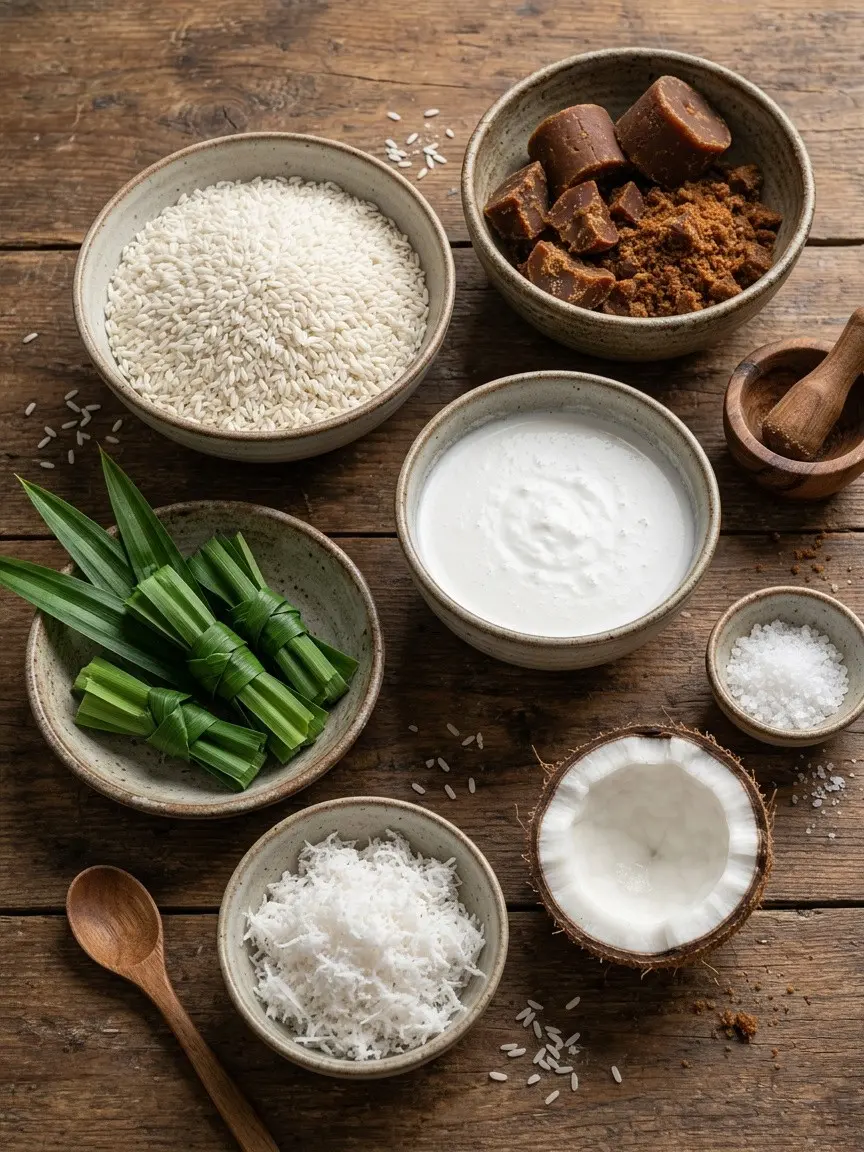
For the biko
- 1 cup glutinous rice (sushi rice)
- 1 1/2 cups water
- 1 pandan leaf
- 1 1/2 cups thick coconut milk
- 1 cup brown sugar, or to taste
- 1/2 teaspoon salt
- Banana leaf, to line the plate or pan
For the latik (toasted coconut curds)
- 2 cups coconut milk or coconut cream, or 1 can
Optional coconut caramel topping
- 2 cups coconut milk
- 1 1/2 cups brown sugar
- 1/2 teaspoon salt
Ingredient Notes
Glutinous rice
Glutinous rice, also called sticky rice, is the heart of biko. It is much stickier than long-grain rice once cooked, which is what lets the cake hold its shape. The source lists it alongside sushi rice, and refers to the cooked rice as sushi rice in the method. Wash it very well in several changes of water before cooking, as the recipe directs.
Pandan leaf
One pandan leaf goes into the pot with the rice and water. It lends a gentle, grassy, vanilla-like fragrance to the rice as it cooks.
Thick coconut milk
The recipe calls for thick coconut milk, and says canned or freshly squeezed both work. Thick coconut milk is what gives the cooked rice its richness.
Brown sugar
A full cup of brown sugar sweetens the rice, and the recipe says to adjust it to taste. The notes also say coconut sugar can be used.
Salt
Only half a teaspoon, but the recipe stresses not to skip it, because salt enhances the taste of the biko.
Banana leaf
Banana leaf lines the plate or shallow pan and is toasted over an open flame first, until slightly wilted. Banana leaf appears in the instructions of the recipe we were given, but not in its ingredient list, so we have added it to the list here.
Coconut milk or cream for the latik
The latik is made from 2 cups of coconut milk or coconut cream, which is about 1 can. As it cooks, the oil separates and the curds toast, and you strain the curds out over a bowl to catch the coconut oil.
Equipment
- A saucepan with a lid for the rice
- A shallow pan for the latik
- A plate or shallow baking pan
- A sieve and a bowl, to strain the curds and catch the oil
- A spoon for stirring and spooning the rice into the pan
- A knife for cutting the squares
- An open flame, such as a gas burner, to toast the banana leaf
A Note About This Recipe
The recipe we were given lists the ingredients, the method, notes, a coconut caramel alternative and nutrition for 1 serving. It does not give a prep time, cook time, total time, pan size, or how many squares it makes. The prep, cook and total times in the recipe card are our own estimates, apart from the 8 to 10 minute rice simmer and the 30 minute cooling time, which come from the source. The nutrition values are from the source, but because the serving size is not defined, treat them as a guide.
Step-by-Step Instructions
Prepare the banana leaf and rice
- Toast the banana leaf over an open flame until it is slightly wilted. Cut off the 4 corners and line a plate or shallow pan with the leaf. Set aside.
- Wash the glutinous rice really well in multiple changes of water. Add it to a saucepan with the water and the pandan leaf.
- Bring it to a full boil, cover, and simmer for 8 to 10 minutes, until the rice is completely cooked.
Cook the biko
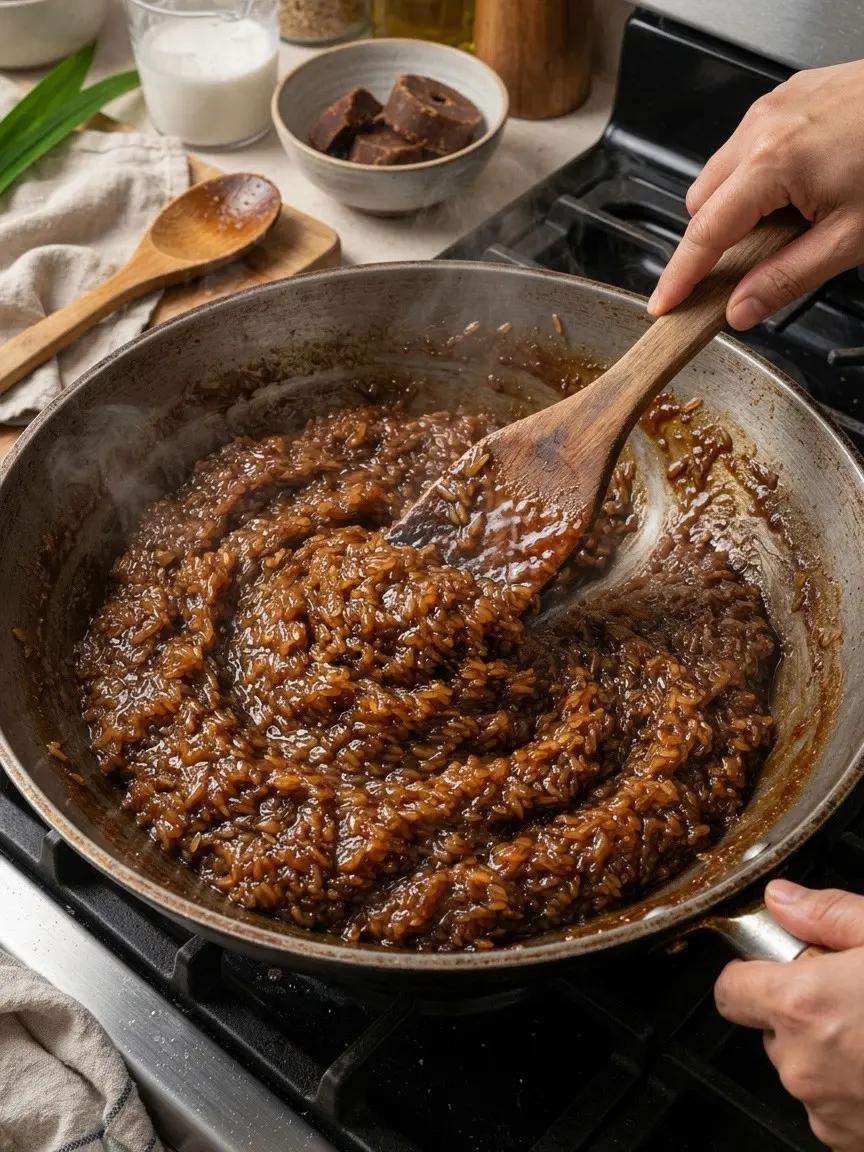
- Add the coconut milk, salt and brown sugar and mix well. The sugar will melt and combine with the cooked rice.
- Cook everything together over low-medium heat until it gets thick and leaves the sides of the pan.
- Spoon the mixture into the banana-leaf-lined pan and leave it to cool for 30 minutes.
Make the latik
- While the rice is cooking, make the latik in a separate pan. Put the coconut milk in a shallow pan and bring it to a full boil over medium-high heat.
- Cook over medium heat, stirring often, until the coconut oil separates from the milk and the curds start to caramelize.
- Strain the toasted curds through a sieve set over a bowl to catch the coconut oil.
Cut and serve
- Use a knife to cut the biko into equal squares and top with the crispy curds. Enjoy.
Tips for the Best Filipino Biko
- Wash the rice thoroughly. The recipe says to wash it really well in several changes of water.
- Cook the rice fully first. Simmer it covered for 8 to 10 minutes until completely cooked before adding the coconut milk.
- Cook until it leaves the sides of the pan. That is the sign the mixture is thick enough to set.
- Taste for sweetness. The sugar is flexible, so adjust it to your liking.
- Do not skip the salt. It brings out the flavor.
- Stir the latik often. Frequent stirring keeps the curds from scorching as they caramelize.
- Save the coconut oil. The strained oil can be kept for other cooking (our suggestion, not part of the source).
- Cool before cutting. Let the biko cool in the pan for 30 minutes so the squares hold together.
Variations
- Coconut caramel instead of latik (from the recipe). Cook 2 cups of coconut milk, 1 1/2 cups of brown sugar and 1/2 teaspoon of salt in a saucepan until syrupy and thick like caramel. Let it cool, then drizzle it over the biko.
- Canned or fresh coconut milk (from the recipe). Either works.
- Brown sugar or coconut sugar (from the recipe). Use whichever you prefer.
Substitutions
- Coconut milk for latik: coconut milk or coconut cream, per the recipe.
- Brown sugar: coconut sugar, per the recipe notes.
- Thick coconut milk: canned or freshly squeezed, per the recipe notes.
- Banana leaf: the recipe uses banana leaf and gives no alternative, so we have not tested a substitute.
Serving Suggestions
Cut the biko into squares and top each one with a spoonful of crispy latik. It suits an afternoon snack, a dessert table, a potluck or a celebration plate. Serve it with coffee or tea.
If you enjoy Filipino sweets, our Royal Bibingka and Cassava Cake with Macapuno make lovely companions on the same table.
Storage
The recipe source does not give storage guidance, so we cannot give tested storage times. As general advice, keep cooled biko covered at room temperature for a short time, or refrigerate it, and bring it back to room temperature before serving. Keep the latik separate so it stays crisp.
Freezing
The recipe source does not cover freezing, and we have not tested it.
Common Mistakes to Avoid
- Not washing the rice well. The recipe stresses several changes of water.
- Undercooking the rice. It should be completely cooked before the coconut milk goes in.
- Stopping too early. If the mixture has not thickened and left the sides of the pan, it will be too soft to cut.
- Leaving out the salt. The biko will taste flat.
- Walking away from the latik. Stir it often as it caramelizes.
- Cutting too soon. Let the biko cool for 30 minutes first.
Frequently Asked Questions
What is biko?
Biko is a Filipino sticky rice cake made from glutinous rice cooked in coconut milk and brown sugar.
What is latik?
Latik is the toasted coconut curds left when coconut milk is cooked until its oil separates and the solids caramelize.
Can I use sushi rice?
The source lists glutinous rice alongside sushi rice. Use glutinous (sticky) rice as written.
Do I need a pandan leaf?
The recipe includes one pandan leaf cooked with the rice for flavor.
Can I use canned coconut milk?
Yes. The recipe says canned or freshly squeezed coconut milk both work.
Can I use coconut sugar?
Yes. The recipe says brown sugar or coconut sugar can be used, and the amount depends on your taste.
How do I know when the biko is ready?
Cook it over low-medium heat until it gets thick and leaves the sides of the pan.
Is there an alternative to latik?
Yes. You can drizzle coconut caramel made from coconut milk, brown sugar and salt.
How many squares does it make?
The source does not say. It depends on the size of your pan and how you cut it.
How many calories are in biko?
The source lists 513 calories per serving, but does not say how large a serving is.
Recipe Background
Biko, sometimes called biko or sticky rice cake, belongs to the Filipino family of kakanin, desserts and snacks made from rice and coconut. Glutinous rice, coconut milk and sugar are cooked together, then topped with latik, the toasted coconut curds that give the dessert its signature crunch. It is a familiar sight at gatherings and celebrations.
This recipe is adapted from the Biko recipe provided to us, written here in our own words with the same ingredients, amounts and method.
Share Your Creation
Did you make this Filipino biko? Leave a comment below and tell us how it turned out. Did you top it with latik or coconut caramel? Your tips help other readers make it their own.
Conclusion
Filipino biko is a chewy, coconut-rich sticky rice cake with a toasty crunch on top. Cook glutinous rice with pandan, stir in coconut milk, brown sugar and salt, cook until thick, cool the rice in a banana-leaf-lined pan, and finish with crispy latik or a coconut caramel drizzle. Slice it into squares and share.
More Delicious Recipes You’ll Love
- Royal Bibingka
- Best Cassava Cake with Macapuno
- Coconut Mango Rice Custard Bake
- The Best Rice Cake with Milk (Torta de Arroz con Leche)
- Magic Coconut & Milk Pudding
Follow Poulef on Pinterest
Loved this recipe? Save it for later and follow @PoulefRecipe on Pinterest for more coconut desserts and easy sweets: https://www.pinterest.com/poulefrecipe/
Nutritional Information
Nutrition values are from the recipe provided, for 1 serving. The source does not say how large a serving is, so treat these as a guide.
| Nutrient | Amount per Serving |
|---|---|
| Calories | 513 |
| Carbohydrates | 65g |
| Protein | 5g |
| Fat | 28g |
| Saturated Fat | 25g |
| Sodium | 226mg |
| Fiber | 1g |
| Sugar | 36g |
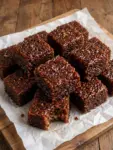
Filipino Biko (Sticky Rice Cake with Coconut Latik)
- Total Time: 1 hour 25 minutes
- Yield: 1 pan of biko, cut into squares 1x
Description
A chewy Filipino sticky rice cake cooked with pandan, thick coconut milk, brown sugar and salt, set on banana leaf and topped with crisp toasted coconut curds (latik).
Ingredients
1 cup glutinous rice (sushi rice)
1 1/2 cups water
1 pandan leaf
1 1/2 cups thick coconut milk
1 cup brown sugar, or to taste
1/2 teaspoon salt
Banana leaf, to line the plate or pan
For the latik (toasted coconut curds): 2 cups coconut milk or coconut cream, or 1 can
Instructions
1. Toast the banana leaf over an open flame until it is slightly wilted. Cut off the 4 corners and line a plate or shallow pan with the leaf. Set aside.
2. Wash the glutinous rice really well in multiple changes of water. Add it to a saucepan with the water and the pandan leaf.
3. Bring to a full boil, cover, and simmer for 8 to 10 minutes, until the rice is completely cooked.
4. Add the coconut milk, salt and brown sugar and mix well. The sugar will melt and combine with the cooked rice.
5. Cook everything together over low-medium heat until it gets thick and leaves the sides of the pan.
6. Spoon the mixture into the banana-leaf-lined pan and leave it to cool for 30 minutes.
7. While the rice cooks, make the latik in a separate shallow pan. Bring the coconut milk to a full boil over medium-high heat.
8. Then cook over medium heat, stirring often, until the coconut oil separates from the milk and the curds start to caramelize.
9. Strain the toasted curds through a sieve set over a bowl to catch the coconut oil.
10. Cut the biko into equal squares with a knife and top with the crispy curds. Enjoy.
Notes
Adapted from the Biko recipe (Filipino sticky rice cake) provided, rewritten in our own words with the same ingredients, amounts and method.
You can use canned coconut milk or freshly squeezed coconut milk.
The amount of sugar depends on your taste. Brown sugar or coconut sugar can be used.
Do not skip the salt. It enhances the taste of the biko.
Instead of latik, you can top the biko with coconut caramel: cook 2 cups coconut milk, 1 1/2 cups brown sugar and 1/2 teaspoon salt in a saucepan until syrupy and thick like caramel, cool, and drizzle over the biko.
The source gave no prep time, cook time, total time, pan size or yield. The times shown are our own estimates, apart from the 8 to 10 minute rice simmer and the 30 minute cooling time, which are from the source.
Nutrition is from the source, for 1 serving. The source does not say how large a serving is.
- Prep Time: 15 minutes
- Cook Time: 40 minutes
- Category: Dessert
- Method: Stovetop
- Cuisine: Filipino
Nutrition
- Serving Size: 1 serving
- Calories: 513
- Sugar: 36g
- Sodium: 226mg
- Fat: 28g
- Saturated Fat: 25g
- Carbohydrates: 65g
- Fiber: 1g
- Protein: 5g
Table of Contents

Gianna Poulef
I’m Gianna Poulef from Poulef Recipes. I love sharing perfected dishes from my kitchen. I’m sure they’ll earn a spot in your heart. Let’s savor this journey together!.
Let’s be friends!