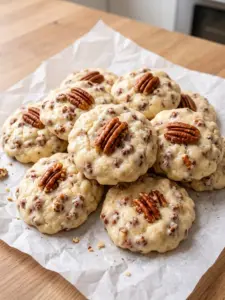


Coconut raspberry thumbprint cookies are tender, buttery cookies with a snowy coat of toasted coconut and a bright spoonful of raspberry jam in the middle. The dough is flavored with cinnamon and a little finely chopped coconut, then each ball is dipped in beaten egg white and rolled in more coconut. In the oven the coconut turns lightly golden, and the jam bakes into a glossy, jewel-red center. They look like little snowballs with a ruby heart, which makes them a favorite for holiday cookie trays.
The method has a few details worth following. The coconut flakes are pulsed in a food processor to small pieces, half a cup goes into the dough and the rest into the coating. The dough is thick, slightly sticky, and chilled for at least 30 minutes. The recipe also explains how to stop thumbprint cookies from cracking or spreading, how to fill them after baking, and how to freeze, store and even ship them. We have kept all of it, in our own words.
A note on the name: you may see these called coconut raspberry and white chocolate thumbprint cookies. The recipe we worked from has no white chocolate, so we have named them for what is actually in them.
Why You’ll Love These Coconut Raspberry Thumbprint Cookies
- Coconut in two ways. Pulsed coconut in the dough and a toasted coconut coating outside.
- Buttery and tender. The dough is made with a full cup of butter, egg yolks and a little cinnamon.
- Bright raspberry center. Jam adds a fruity tang that cuts through the richness.
- Make-ahead dough. Chill the dough from 30 minutes up to 24 hours.
- Freezer-friendly. Freeze the unbaked dough balls for up to 3 months.
- Flexible fillings. The recipe suggests other jams, guava jelly, Meyer lemon curd or cajeta.
- Good for gifting. The recipe includes tips for packing and shipping them.
What Do They Taste Like?
The cookie is soft, short and buttery, with a gentle warmth from cinnamon and vanilla. The outside is lightly toasted and a little chewy from the coconut, and it picks up a nutty, caramelized flavor as it bakes. The raspberry jam in the middle is sweet and tart, and it balances the rich coconut and butter. Each bite has a mix of crisp coconut, soft cookie and sticky jam.
Ingredients
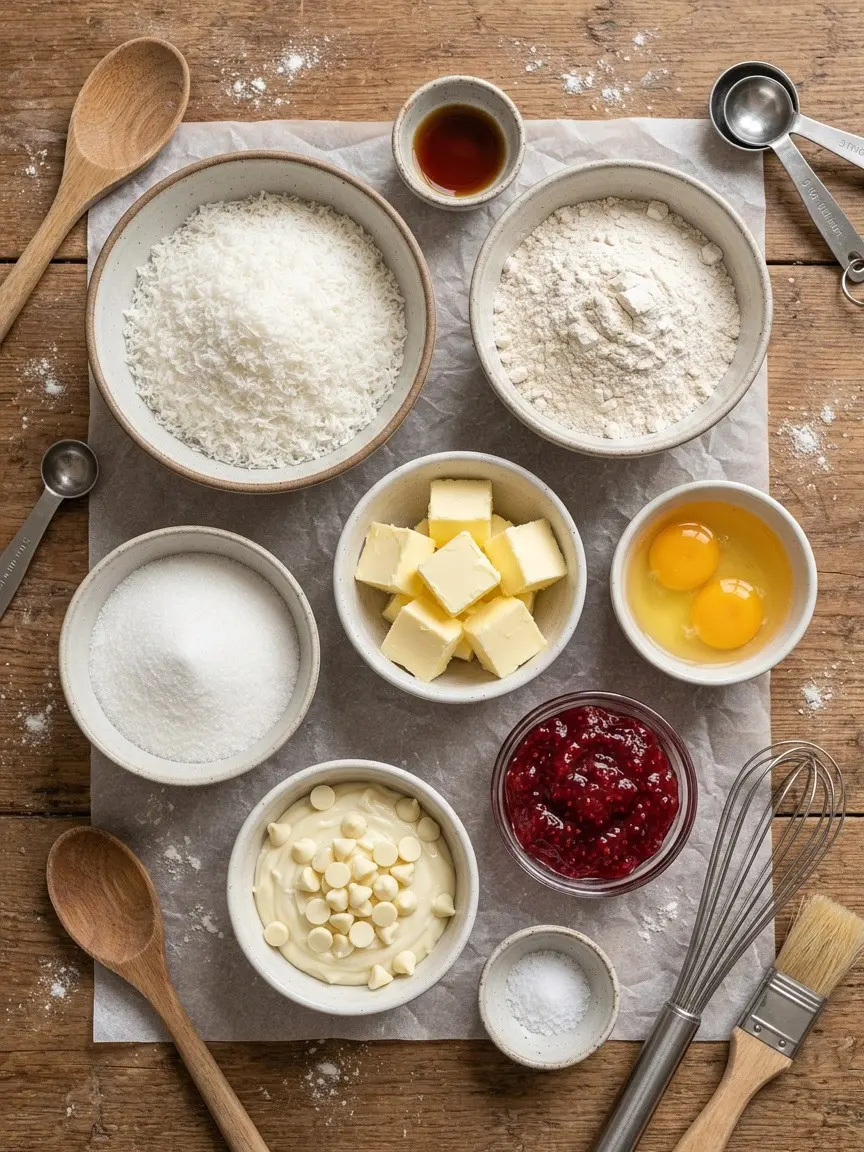
For the coconut and the dough
- 2 cups (165 g) sweetened coconut flakes
- 2 cups (270 g) all-purpose flour
- 1 teaspoon (3 g) ground cinnamon
- 1/2 teaspoon (3 g) baking powder
- 1/4 teaspoon kosher salt
- 1 cup (2 sticks, 226 g) unsalted butter, at room temperature
- 1/3 cup (75 g) granulated sugar
- 1/4 cup (65 g) light brown sugar, packed
- 2 large eggs, whites separated from yolks, at room temperature
- 2 teaspoons (10 mL) vanilla extract
For the filling
- 1/2 cup (155 g) raspberry jam
For baking and chilling
- Silicone baking mats, to line the sheet pans
- Plastic wrap, for chilling the dough
Ingredient Notes
Sweetened coconut flakes
Two cups (165 g) of sweetened coconut flakes are pulsed to small pieces, about 1/4 inch long. Half a cup goes into the dough, and the remaining 1 1/2 cups are for rolling the cookies. You can replace the coconut with toasted hazelnuts or almonds processed to a fine crumb, but pulse them until they look like the pulsed coconut.
Flour, cinnamon, baking powder and salt
Two cups (270 g) of all-purpose flour, 1 teaspoon of cinnamon, 1/2 teaspoon of baking powder and 1/4 teaspoon of kosher salt are whisked together with the pulsed coconut.
Butter and sugars
One cup (2 sticks, 226 g) of unsalted butter at room temperature, 1/3 cup of granulated sugar and 1/4 cup of packed light brown sugar are blended into a thick paste.
Eggs
Two large eggs at room temperature are separated. The yolks go into the dough, one at a time, and the whites are beaten and used as the glue that holds the coconut coating on.
Vanilla
Two teaspoons (10 mL) of vanilla extract go in with the last yolk. The recipe says you can swap in almond extract, pure lemon extract or rosewater.
Raspberry jam
Half a cup (155 g) of raspberry jam fills the thumbprints. The recipe suggests that other fruit jams, guava jelly, Meyer lemon curd or cajeta also work.
Equipment
- A food processor with a blade attachment
- An electric mixer (handheld or stand)
- Two mixing bowls, and a wide, shallow bowl for the coconut
- A whisk
- 2 or 3 sheet pans, lined with silicone baking mats
- A 1/2 teaspoon measuring spoon, for pressing the dent and filling the jam
- Plastic wrap
- A cooling rack
A Note About This Recipe
The recipe we were given lists the ingredients in cups and grams, a long, detailed method, notes on swaps, tips, storage, freezing and shipping, and nutrition for 1 cookie. It does not give a yield, prep time or total time. The prep and total times in the recipe card are our own estimates, apart from the stated chilling, baking and cooling times. The source does not say how many cookies the recipe makes, and its nutrition figures are for 1 cookie.
Step-by-Step Instructions
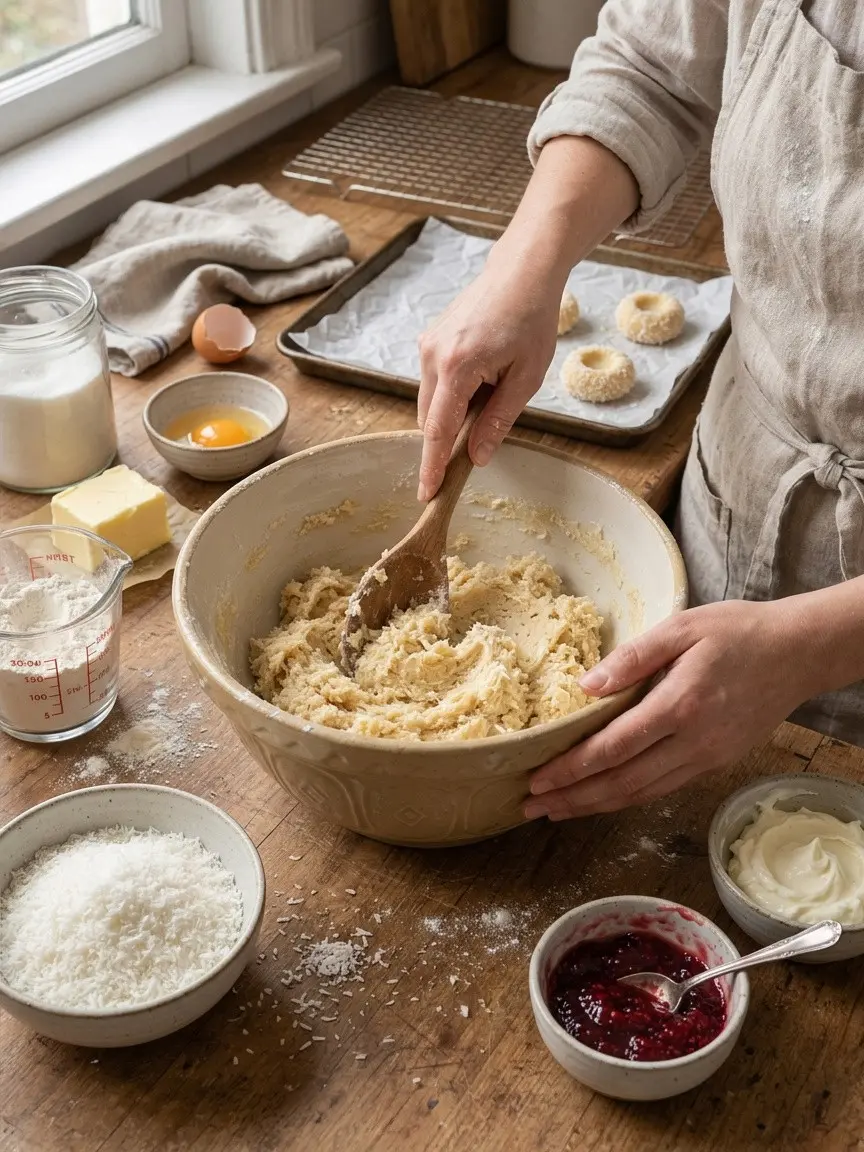
Pulse the coconut
- Add the coconut flakes to a food processor fitted with the blade attachment and pulse until the pieces are about 1/4 inch long. Measure out 1/2 cup of the pulsed coconut for the dough and keep the remaining 1 1/2 cups to roll the cookies in later.
Make the dough
- In a mixing bowl, whisk together the 1/2 cup of coconut, flour, cinnamon, baking powder and salt.
- In a separate bowl, blend the butter, granulated sugar and brown sugar at medium-low speed until they form a thick paste. Stop the mixer and scrape down the bowl and beaters.
- Add the egg yolks one at a time, blending on low speed to mix each in thoroughly, then stopping to scrape the bowl and beaters before the next yolk. Add the vanilla with the last yolk, then stop and scrape again.
- Add the dry ingredients in three stages, blending on low speed just until the flour is mixed in each time and scraping the bowl and beaters before the next third. The dough will be thick but still slightly sticky.
Chill the dough
- Scrape the dough onto a sheet of plastic wrap, form it into a square, wrap it and refrigerate for at least 30 minutes.
Roll and coat the cookies
- Take the chilled dough out of the fridge about 15 minutes before baking. Preheat the oven to 350°F (177°C) and line 2 or 3 sheet pans with silicone baking mats. Put the remaining 1 1/2 cups of coconut in a wide, shallow bowl.
- Beat the egg whites vigorously until foamy and smooth, and let them sit while you shape the dough.
- Cut the dough into 1-inch squares or chunks about the size of walnuts. Pinch each piece between your thumb and fingers to loosen it, then roll it between your palms into a ball and set it on the mat. Repeat with the rest of the dough.
- Toss the dough balls in the beaten egg whites, letting the excess drip off. Transfer them to the bowl of coconut and roll with your fingers until the whole surface is coated like a snowball. Lift each ball out, toss it between your hands to shake off loose coconut, and lay it on the sheet pan.
- Press the bottom of a 1/2 teaspoon measuring spoon into the center of each ball. The spoon will stick, so twist it to the left or right as you lift it out.
Fill and bake
- Fill each indentation with raspberry jam, using the same 1/2 teaspoon.
- Bake in the preheated 350°F (177°C) oven for 15 to 18 minutes, until the coconut is slightly toasted.
- Let the cookies cool on the pan for 3 to 5 minutes, then transfer them to a cooling rack to cool completely.
Tips for the Best Thumbprint Cookies
- Chill the dough. From 30 minutes up to 24 hours. Resting lets the flour absorb the liquids and plump up.
- Roll in coconut just before baking. If you coat the balls too early, the egg whites dry and the surface looks cracked.
- Let the dough warm slightly. At least 15 to 20 minutes on the counter helps prevent cracks when you press the dent.
- Close any cracks. If a cookie still cracks, press the dough back together.
- Use a silicone baking mat. It helps keep the cookies from spreading. Parchment paper is the next best option.
- Chill the second pan. If the first pan spread, chill the next one for at least 15 minutes before baking.
- Twist the spoon. The measuring spoon sticks in the dough, so twist it as you lift.
- Add the jam by the half teaspoon. Use the same spoon to fill each dent.
- Watch the coconut. The cookies are done when it is slightly toasted.
- Try filling after baking. Bake 15 minutes, press the dents while the cookies are soft, fill with jam and bake 5 minutes more to firm up the jam.
Variations
These variations all come from the recipe:
- Nut version. Replace the coconut with toasted hazelnuts or almonds processed to a fine crumb.
- Different extract. Use almond extract, pure lemon extract or rosewater in place of the vanilla.
- Different fillings. Use your favorite fruit jam, guava jelly, Meyer lemon curd or cajeta.
- Fill after baking. A second way to fill the cookies, described in the tips above.
Substitutions
- Coconut flakes: toasted hazelnuts or almonds, processed to a fine crumb.
- Vanilla extract: almond extract, pure lemon extract or rosewater.
- Raspberry jam: any fruit jam, guava jelly, Meyer lemon curd or cajeta.
- Silicone baking mats: parchment paper.
- Butter, flour and eggs: the recipe gives no substitutions, and we have not tested any.
Serving Suggestions
Serve the cookies at room temperature, with coffee or tea. They are an attractive addition to holiday cookie trays, gift tins and dessert tables, where the white coconut and red jam stand out. For more jam-filled and coconut cookies, see our Coconut Jam Thumbprint Cookies and White Chocolate Almond Cookies.
Storage
Store the cookies in a covered container at room temperature for 3 days. The recipe says to avoid storing them in the refrigerator, because the cold air makes them go stale faster.
Freezing
Unbaked cookie dough
- Mix the dough as directed.
- Form the chilled dough into 1-inch balls and arrange them on a silicone-lined sheet pan.
- Freeze the balls until solid, then transfer them to a freezer bag and freeze for up to 3 months.
- To use, arrange the frozen balls on a silicone-lined sheet pan and let them thaw for 20 to 30 minutes at room temperature before coating and filling.
Baked cookies
- Before filling them with jam, underbake the cookies by 5 minutes.
- Cool the cookies completely.
- Transfer them to a container and freeze for up to 2 months.
- When you are ready, thaw the cookies at room temperature and fill them as directed.
- Bake the filled cookies at 350°F (177°C) for 5 minutes to firm up the jam, and they are ready to enjoy.
The recipe warns against freezing the cookies with jam already in them. The water in the jam bleeds into the cookie as it thaws, making it soggy and quicker to mold.
Shipping the Cookies
- Add 1 tablespoon of vital wheat gluten to the dough, which the recipe says extends the shelf life.
- Bake as directed, then pack the cookies in an airtight container, separating the layers with wax paper so the jam does not stick to the cookie below.
- Wrap the container in plastic to seal it, then wrap it in bubble wrap to prevent breakage.
- Seal the shipping box and ship the cookies within 24 hours of baking them.
Common Mistakes to Avoid
- Coating the balls too early. The egg whites dry, and the cookies look cracked.
- Using warm dough. Warm dough spreads in the oven.
- Using cold, stiff dough. It can crack when you press the dent. Let it warm 15 to 20 minutes.
- Skipping the chill. The dough needs at least 30 minutes.
- Storing the cookies in the fridge. The cold air makes them stale faster.
- Freezing filled cookies. The jam can make them soggy after thawing.
- Not scraping the bowl. Scrape between additions so the dough mixes evenly.
Frequently Asked Questions
Is there white chocolate in these cookies?
No. The recipe we used has no white chocolate. The cookies are coconut cookies filled with raspberry jam.
Why do I pulse the coconut?
Pulsing makes small pieces about 1/4 inch long. Half a cup goes into the dough, and the rest coats the cookies.
Why do I use egg whites?
Beaten egg whites act as a glue, so the coconut sticks to the dough balls.
How do I stop the cookies from cracking?
Let the dough warm on the counter for at least 15 to 20 minutes. If they still crack, press the dough back together.
Why did my cookies spread?
The dough was probably too warm. A silicone baking mat helps, and you can chill the pan for at least 15 minutes before baking.
Can I fill the cookies after baking?
Yes. Bake for 15 minutes, press the dent while the cookies are soft, fill with jam and bake for 5 minutes more.
How long do they keep?
3 days in a covered container at room temperature. Do not refrigerate them.
Can I use other jams?
Yes. The recipe suggests your favorite fruit jam, guava jelly, Meyer lemon curd or cajeta.
How many cookies does this make?
The source does not say. You cut the dough into 1-inch squares or walnut-sized pieces.
How many calories are in a cookie?
The source lists 201 calories per cookie.
Recipe Background
Thumbprint cookies are a classic of cookie baking. A small ball of dough is pressed with a thumb or the back of a spoon, then filled with jam, curd or chocolate. Coating the dough in coconut or finely chopped nuts before baking is a common variation, because the coating toasts in the oven and adds crunch. Here, coconut flakes play that role, and a spoonful of raspberry jam gives the cookie its color.
This recipe is adapted from the coconut raspberry thumbprint cookies recipe on Sense and Edibility, written here in our own words with the same ingredients, amounts and method.
Share Your Creation
Did you make these coconut raspberry thumbprint cookies? Leave a comment below and tell us how they turned out. Which jam did you use, and did you fill them before or after baking? Your tips help other readers.
Conclusion
Coconut raspberry thumbprint cookies take a little time, and they are worth it. Pulse the coconut, mix the buttery dough, chill it, roll the balls in egg white and coconut, press a thumbprint and fill with jam. Bake until the coconut is slightly toasted, cool and enjoy. They store for a few days and freeze well, so they suit holiday baking.
More Delicious Recipes You’ll Love
- Irresistible Coconut Jam Thumbprint Cookies
- White Chocolate Almond Cookies
- Raspberry Cheesecake Balls
- Coral Lace Raspberry Cups with White Chocolate Cream
- Apricot Coconut Hungarian Tarts
Follow Poulef on Pinterest
Loved this recipe? Save it for later and follow @PoulefRecipe on Pinterest for more cookies and holiday baking: https://www.pinterest.com/poulefrecipe/
Nutritional Information
Nutrition values are from the recipe provided, for 1 cookie. The source does not say how many cookies the recipe makes, so treat these as a guide.
| Nutrient | Amount per Serving |
|---|---|
| Calories | 201 |
| Carbohydrates | 25g |
| Protein | 2g |
| Fat | 10g |
| Saturated Fat | 8g |
| Trans Fat | 1g |
| Cholesterol | 27mg |
| Sodium | 73mg |
| Fiber | 2g |
| Sugar | 11g |

Coconut Raspberry Thumbprint Cookies (Toasted Coconut Snowballs)
- Total Time: 1 hour 25 minutes
- Yield: Cookies (the source does not give a number)
Description
Buttery cinnamon cookie dough with coconut, rolled in egg white and sweetened coconut flakes, pressed with a thumbprint, filled with raspberry jam and baked until the coconut is slightly toasted.
Ingredients
2 cups (165 g) sweetened coconut flakes
2 cups (270 g) all-purpose flour
1 teaspoon (3 g) ground cinnamon
1/2 teaspoon (3 g) baking powder
1/4 teaspoon kosher salt
1 cup (2 sticks, 226 g) unsalted butter, at room temperature
1/3 cup (75 g) granulated sugar
1/4 cup (65 g) light brown sugar, packed
2 large eggs, whites separated from yolks, at room temperature
2 teaspoons (10 mL) vanilla extract
1/2 cup (155 g) raspberry jam
Silicone baking mats, to line the sheet pans
Plastic wrap, for chilling the dough
Instructions
1. Add the coconut flakes to a food processor fitted with the blade attachment and pulse until the pieces are about 1/4 inch long. Measure out 1/2 cup of the pulsed coconut for the dough and keep the remaining 1 1/2 cups to roll the cookies in later.
2. In a mixing bowl, whisk together the 1/2 cup of coconut, flour, cinnamon, baking powder and salt.
3. In a separate bowl, blend the butter, granulated sugar and brown sugar at medium-low speed until they form a thick paste. Stop the mixer and scrape down the bowl and beaters.
4. Add the egg yolks one at a time, blending on low speed to mix each in thoroughly, then stopping to scrape the bowl and beaters before the next yolk. Add the vanilla with the last yolk, then stop and scrape again.
5. Add the dry ingredients in three stages, blending on low speed just until the flour is mixed in each time and scraping the bowl and beaters before the next third. The dough will be thick but still slightly sticky.
6. Scrape the dough onto a sheet of plastic wrap, form it into a square, wrap it and refrigerate for at least 30 minutes.
7. Take the chilled dough out of the fridge about 15 minutes before baking. Preheat the oven to 350°F (177°C) and line 2 or 3 sheet pans with silicone baking mats. Put the remaining 1 1/2 cups of coconut in a wide, shallow bowl.
8. Beat the egg whites vigorously until foamy and smooth, and let them sit while you shape the dough.
9. Cut the dough into 1-inch squares or chunks about the size of walnuts. Pinch each piece between your thumb and fingers to loosen it, then roll it between your palms into a ball and set it on the mat. Repeat with the rest of the dough.
10. Toss the dough balls in the beaten egg whites, letting the excess drip off. Transfer them to the bowl of coconut and roll with your fingers until the whole surface is coated like a snowball. Lift each ball out, toss it between your hands to shake off loose coconut, and lay it on the sheet pan.
11. Press the bottom of a 1/2 teaspoon measuring spoon into the center of each ball. The spoon will stick, so twist it to the left or right as you lift it out.
12. Fill each indentation with raspberry jam, using the same 1/2 teaspoon.
13. Bake in the preheated 350°F (177°C) oven for 15 to 18 minutes, until the coconut is slightly toasted.
14. Let the cookies cool on the pan for 3 to 5 minutes, then transfer them to a cooling rack to cool completely.
Notes
Adapted from the coconut raspberry thumbprint cookies recipe on Sense and Edibility, rewritten in our own words with the same ingredients, amounts and method. This recipe has no white chocolate.
Swaps: the coconut flakes can be replaced with toasted hazelnuts or almonds processed to a fine crumb, the vanilla with almond extract, pure lemon extract or rosewater, and the raspberry jam with your favorite fruit jam, guava jelly, Meyer lemon curd or cajeta.
If you use nuts instead of coconut, pulse them until they look like the pulsed coconut.
The dough can be chilled from 30 minutes up to 24 hours. Chilling lets the flour absorb the liquids and plump up.
Roll the dough in coconut just before baking. If you do it too far ahead, the egg whites dry and the cookies get a cracked-looking surface.
To fill after baking instead: bake the cookies for 15 minutes, make the dent while they are still soft, fill with jam and return the pans to the oven for another 5 minutes to firm up the jam.
To avoid cracks, let the dough warm on the counter for at least 15 to 20 minutes. If cookies still crack after you press the dent, press the dough back together to close the cracks.
If the cookies spread, the dough was too warm. A silicone baking mat helps prevent spreading, and parchment paper is the next best option. If the first pan spread, chill the second pan for at least 15 minutes before baking.
Storage: keep the cookies in a covered container at room temperature for 3 days. Do not refrigerate them, because the cold air makes them go stale faster.
Freezing unbaked dough: form the chilled dough into 1-inch balls on a silicone-lined sheet pan, freeze until solid, then transfer to a freezer bag for up to 3 months. To use, arrange the frozen balls on a lined sheet pan and let them thaw for 20 to 30 minutes at room temperature before coating and filling.
Freezing baked cookies: underbake them by 5 minutes before filling, cool completely and freeze in a container for up to 2 months. Thaw at room temperature, fill with jam and bake at 350°F (177°C) for 5 minutes to firm up the jam. Cookies frozen with jam in them can turn soggy and mold faster.
Shipping: add 1 tablespoon of vital wheat gluten to the dough to extend shelf life. Bake as directed, pack the cookies in an airtight container with wax paper between the layers, wrap the container in plastic and then bubble wrap, and ship within 24 hours of baking.
The source gave no yield, prep time or total time. The prep and total times shown are our own estimates, apart from the 30 minute chill, the 15 to 18 minute bake and the 3 to 5 minute cool. Nutrition is from the source, for 1 cookie, and the source does not say how many cookies the recipe makes.
- Prep Time: 35 minutes
- Cook Time: 18 minutes
- Category: Dessert
- Method: Baking
- Cuisine: North American
Nutrition
- Serving Size: 1 cookie
- Calories: 201
- Sugar: 11g
- Sodium: 73mg
- Fat: 10g
- Saturated Fat: 8g
- Trans Fat: 1g
- Carbohydrates: 25g
- Fiber: 2g
- Protein: 2g
- Cholesterol: 27mg
Table of Contents

Gianna Poulef
I’m Gianna Poulef from Poulef Recipes. I love sharing perfected dishes from my kitchen. I’m sure they’ll earn a spot in your heart. Let’s savor this journey together!.
Let’s be friends!