
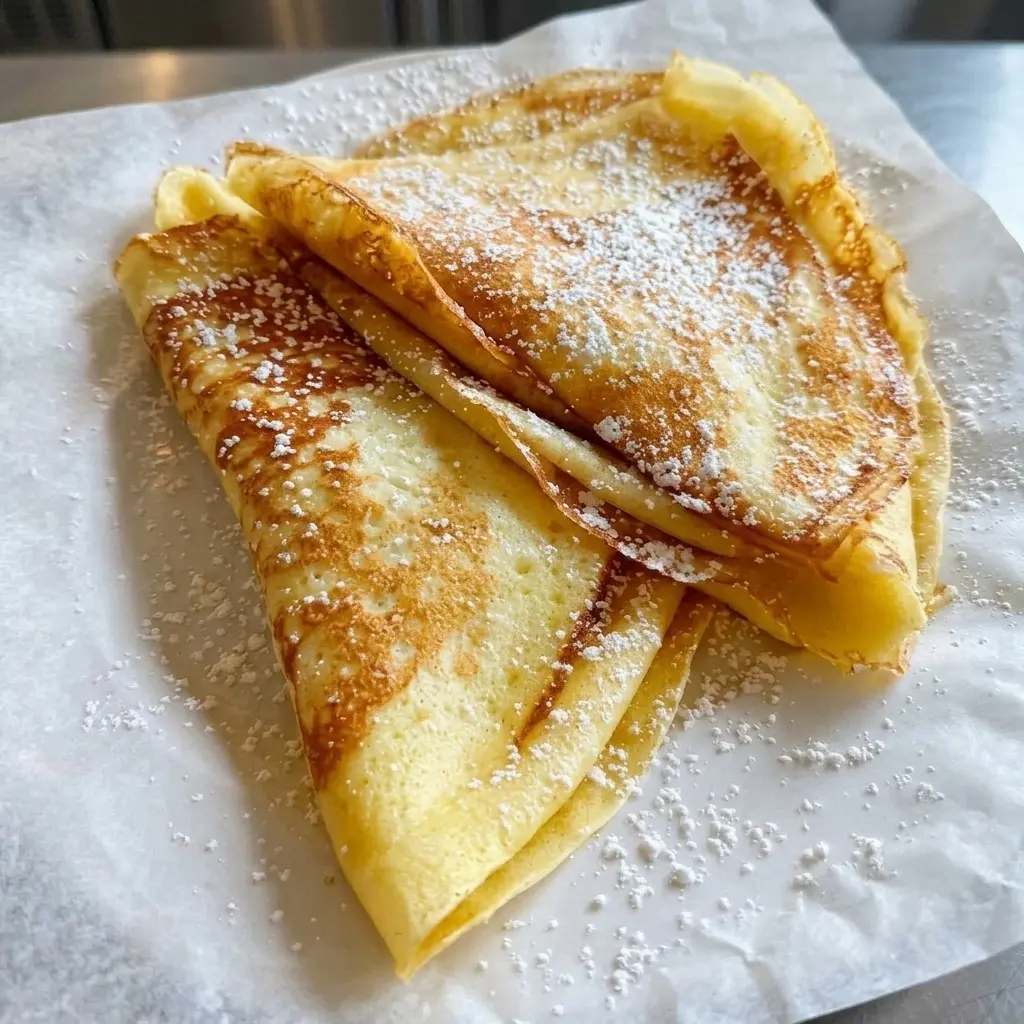
Thin, lacy-edged, and tender, French crepes are one of the simplest and most versatile things you can make with pantry staples. A smooth batter of flour, eggs, milk, melted butter, and a pinch of salt is poured into a hot pan, swirled thin, and cooked in about a minute per side. Fill them with sweet or savory toppings, fold them into triangles, roll them up, or stack them high.
In France, crepes are an everyday comfort food and a celebration treat, eaten for breakfast, dessert, or a quick supper. The classic batter is gently flavored, buttery and very lightly eggy, which makes it a blank canvas. That means a drizzle of lemon and sugar can be just as good as chocolate spread and sliced bananas, or ham and cheese.
This recipe makes a thin, flexible crepe that does not tear easily. The key steps are simple: blend the batter until smooth, let it rest so the flour can hydrate, and cook in a lightly buttered pan over medium heat. Once you have the rhythm, crepes come together quickly, and the batter can even be made a day ahead.
Why You’ll Love This Recipe
- Made with just a few basic ingredients you probably already have
- A quick blender batter that takes about 10 minutes
- Thin, tender crepes that roll and fold without tearing
- Works for sweet or savory fillings, so one batter serves any meal
- The batter keeps in the refrigerator for up to 24 hours
- Great for feeding a crowd, since you can stack and keep them warm
- A fun, hands-on breakfast or brunch everyone can customize
They are also an easy way to turn a few simple ingredients into something that feels special.
What Do French Crepes Taste Like?
Classic French crepes taste mild, buttery, and slightly sweet from the milk and browned butter. They are much thinner than American pancakes, with a soft, delicate, almost silky texture and golden, lightly crisp edges. Because the batter has little or no sugar, the crepe itself tastes neutral and creamy, so it takes on whatever you fill it with, from lemon and sugar to Nutella and berries to ham and cheese.
Recipe Overview
- Prep time: 10 minutes, plus at least 30 minutes of resting
- Cook time: About 20 minutes
- Yield: About 8 crepes
- Difficulty: Easy
- Method: Blended batter cooked on the stovetop
Ingredients
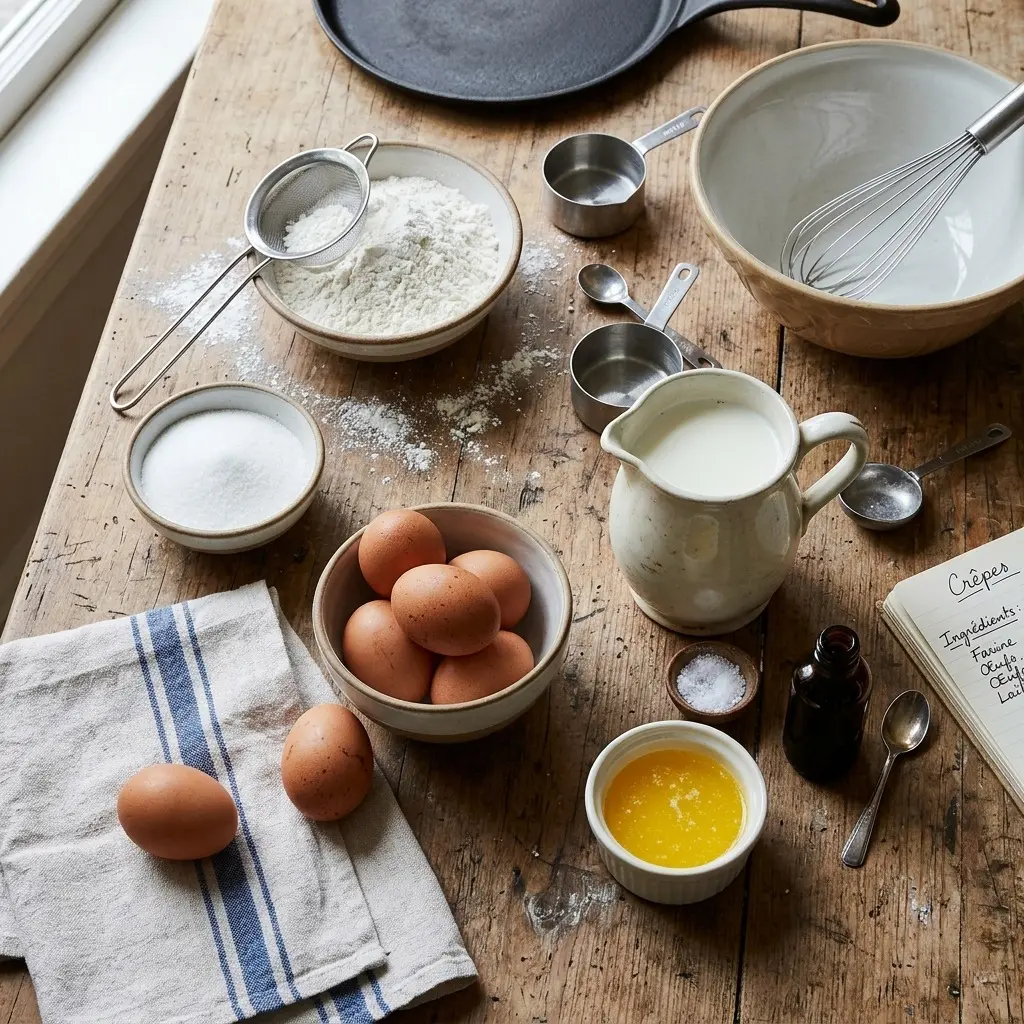
- 1 cup (125 g) all-purpose flour
- 2 large eggs
- 1 cup (240 ml) milk
- 1/4 cup (60 ml) water
- 2 tablespoons (28 g) unsalted butter, melted, plus more for the pan
- 1 pinch salt
Ingredient Notes
Flour: Plain all-purpose flour is all you need. Measure by weight if you can, or spoon it into the cup and level it so the batter does not become too thick.
Eggs: They give the crepes structure and richness. Room-temperature eggs blend into the batter more smoothly than cold ones.
Milk and water: Milk gives tenderness and flavor, and a little water thins the batter and keeps the crepes light. Many recipes use both, because a batter made only with milk can turn out slightly thicker.
Butter: Melted butter in the batter adds flavor and helps prevent sticking, and a little more is used to grease the pan. Let it cool slightly before blending so it does not cook the eggs.
Salt: A small pinch balances the flavor even in sweet crepes.
Sugar and vanilla (optional): A classic crepe batter has no sugar. If you plan to serve them sweet, you can add a teaspoon or two of sugar and a splash of vanilla to the batter.
Kitchen Tools You’ll Need
- Blender, or a large bowl and whisk
- 8- to 10-inch nonstick skillet or crepe pan
- Small ladle or 1/4-cup measure
- Thin spatula for flipping
- Pastry brush or paper towel for buttering the pan
- Plate for stacking the cooked crepes
Substitutions and Variations
- Sweet crepes: Add 1 to 2 teaspoons of sugar and a little vanilla extract to the batter.
- Savory crepes: Leave out the sugar and fill with cheese, ham, spinach, mushrooms, or eggs. Traditional savory crepes in France are often made with buckwheat flour.
- Buckwheat flour: Replace part of the flour with buckwheat flour for a nuttier, more traditional savory crepe.
- All milk: Use milk in place of the water for a slightly richer crepe, adding a splash more if the batter is too thick.
- Dairy-free: Plant-based milk and a dairy-free butter alternative can be used, although the flavor and browning will differ and this has not been tested here.
- Lemon zest: Stir in a little grated lemon zest for bright flavor in sweet crepes.
- Larger batch: Double the ingredients for a crowd and keep cooked crepes warm in a low oven.
How to Make French Crepes
Crepes follow a simple pattern: blend the batter, rest it, then cook it in a hot buttered pan. A single crepe cooks in about a minute, so once you start it moves quickly. The first crepe is often a test, so do not worry if it is not perfect.
Step-by-Step Instructions
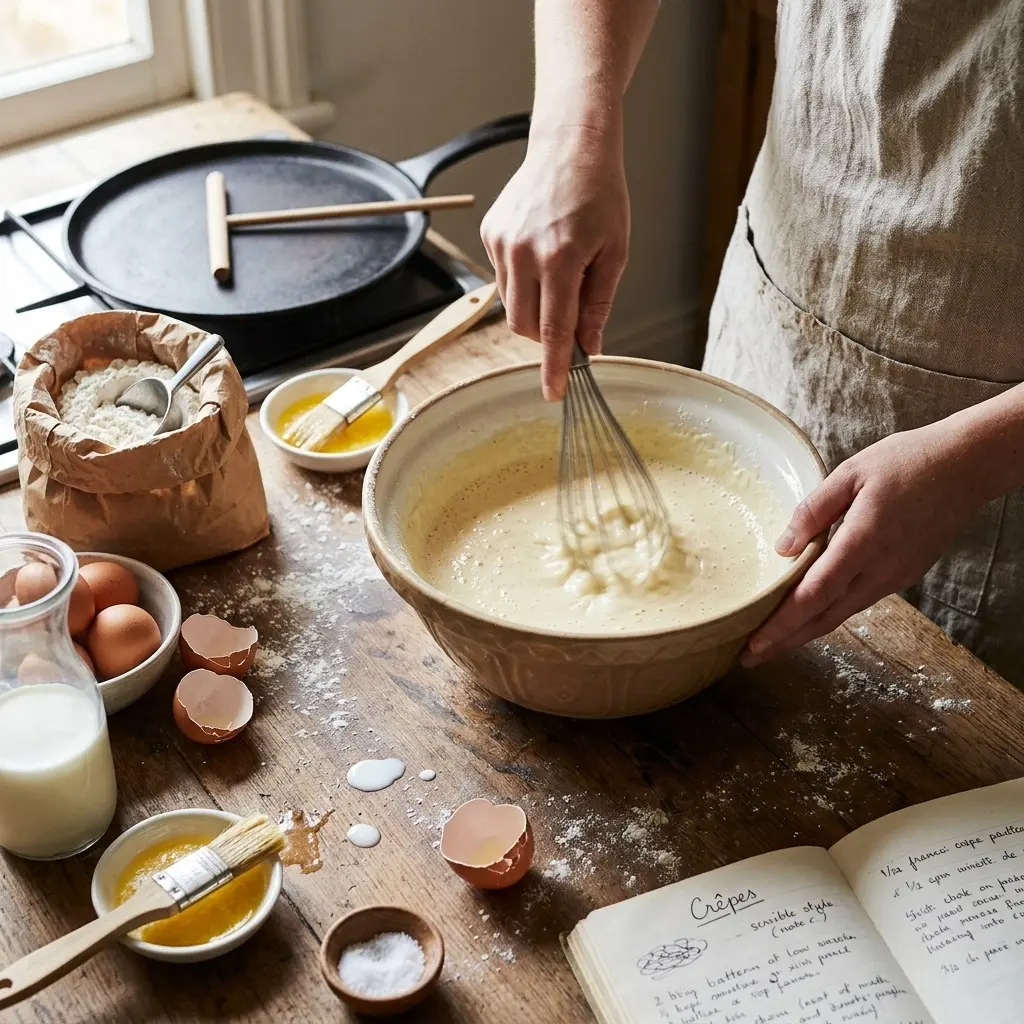
- Make the batter. Combine the eggs, milk, water, melted butter, and salt in a blender or large bowl. Add the flour and blend or whisk until completely smooth. The batter should be thin, close to the consistency of heavy cream.
- Rest the batter. Cover and rest the batter in the refrigerator for at least 30 minutes, or up to 24 hours. Stir or whisk briefly before using.
- Heat the pan. Heat an 8- to 10-inch nonstick skillet or crepe pan over medium heat and brush lightly with butter.
- Pour and swirl. Pour about 1/4 cup (60 ml) of batter into the center of the pan and immediately tilt and swirl so the batter coats the bottom in a thin, even layer.
- Cook and flip. Cook for about 1 minute, until the edges lift and the underside is lightly golden. Flip and cook the second side for 30 to 60 seconds.
- Stack. Slide the crepe onto a plate. Repeat with the remaining batter, buttering the pan lightly as needed and stacking the crepes.
- Fill and serve. Fill and fold or roll the crepes with your favorite sweet or savory fillings and serve warm.
Tips for Success
- Blend the batter until completely smooth, then rest it. Resting gives the flour time to absorb the liquid and relaxes the gluten, which makes more tender crepes.
- Keep the batter as thin as heavy cream. If it seems thick, whisk in a splash of milk.
- Use a nonstick pan and only a light film of butter, so the crepes brown evenly and do not turn greasy.
- Swirl quickly right after pouring, because the batter sets fast.
- Do not overheat the pan. Medium heat gives a golden crepe without burning the butter.
- Expect the first crepe to be a test. Adjust the heat or batter thickness as needed.
- Stir the batter again between crepes, since the flour can settle.
- Keep cooked crepes covered with a clean towel or in a low oven so they stay soft and warm.
How to Know It’s Done
A crepe is ready to flip when the surface looks dry, the edges turn light golden and start to lift from the pan, and the underside is lightly browned, usually after about a minute. The second side needs only 30 to 60 seconds. Finished crepes should be thin, pliable, and lightly speckled with gold, not crisp.
What to Serve With French Crepes
Crepes are endlessly flexible. Try them with:
- Lemon juice and a sprinkle of sugar, the simplest French classic
- Chocolate-hazelnut spread with sliced banana or strawberries
- Whipped cream and fresh berries
- Jam, honey, or maple syrup
- Ham, cheese, and a fried egg for a savory version
- Sauteed mushrooms or spinach with cheese
For more fruit-and-cream ideas, take inspiration from the whipped cream filling in this Vanilla Swiss Roll or the strawberry sauce topping on 2-Ingredient No-Bake Cheesecake Bites.
Storage Instructions
Stack the cooled crepes with a small piece of parchment paper between them, wrap them tightly, and refrigerate for up to 2 to 3 days. Rewarm them briefly in a skillet or the microwave, covered, before filling. The uncooked batter can be refrigerated in a covered container for up to 24 hours. Stir it well before using.
Freezing Instructions
Stack the completely cooled crepes with parchment between each one, wrap tightly in plastic wrap and foil or place in a freezer bag, and freeze for up to 2 months. Thaw them in the refrigerator overnight or at room temperature for about an hour, then warm them gently before using. Freezing has not been tested for this exact recipe.
Common Mistakes
- Skipping the rest. Unrested batter can give tougher, more fragile crepes.
- Batter too thick. It makes heavy, pancake-like crepes. Thin it with a splash of milk.
- Pan too hot. Crepes brown too quickly and cannot be swirled thin. Use medium heat.
- Pan too cool. The batter spreads slowly and the crepe turns pale and rubbery.
- Too much butter in the pan. It fries the crepe and makes it greasy. A thin film is enough.
- Lumpy batter. Blend until smooth, or strain the batter through a sieve if lumps remain.
- Flipping too early. Wait until the edges lift and the underside is golden so the crepe does not tear.
Frequently Asked Questions
Do I have to rest the crepe batter?
Most recipes recommend resting the batter for at least 30 minutes. It allows the flour to absorb the liquid and the gluten to relax, which helps the crepes stay tender and less likely to tear.
Why are my crepes tearing?
The batter may be too thick or unrested, the pan too hot, or you may be flipping too soon. Wait until the edges lift and the bottom is golden, and use a thin spatula.
How thin should the batter be?
It should flow easily and be close to the consistency of heavy cream, much thinner than pancake batter.
Can I make the batter ahead?
Yes. Cover and refrigerate it for up to 24 hours, then whisk it before cooking.
Are crepes the same as pancakes?
No. Crepes are much thinner, with no leavening, so they cook flat and stay soft and flexible, while pancakes are thick and fluffy.
Can I make crepes without a blender?
Yes. Whisk the wet ingredients, then gradually whisk in the flour until smooth, and strain through a sieve if any lumps remain.
Can I make them savory?
Yes. This batter has no sugar, so it works well with savory fillings such as ham, cheese, mushrooms, or spinach.
Do I need a special crepe pan?
No. A regular nonstick skillet works fine, preferably with a shallow edge so the spatula slides under easily.
Recipe Background
Crepes originated in Brittany in northwestern France and spread across the country, where they became a beloved everyday food. In France, they are traditionally eaten on Candlemas, February 2, when it is said that flipping a crepe with a coin in your hand brings prosperity for the year. Buckwheat crepes, known as galettes, are the traditional savory version in Brittany, while wheat flour crepes are typically served sweet. The standard recipe is made with flour, eggs, milk, salt, and butter, and the technique is simple enough that it remains a staple of home cooking and street food stands alike.
Conclusion
French crepes prove how much you can do with a handful of everyday ingredients. A quick blender batter, a short rest, and a hot buttered pan give you thin, tender crepes that suit any meal. Make a batch for a lazy weekend breakfast, set out a few fillings, and let everyone build their own. If you try them, leave a comment and tell me your favorite filling.
More Delicious Recipes You’ll Love
- 2-Ingredient Cottage Cheese Pancakes
- Banana Oat Cottage Cheese Pancake Bites
- 3-Ingredient Blueberry Oat Breakfast Cake
- French Yogurt Cake
- Banana Pudding Cheesecake
Follow Poulef on Pinterest
Loved this recipe? Save it for later and follow @PoulefRecipe on Pinterest for more cozy, comforting bakes: https://www.pinterest.com/poulefrecipe/
Nutritional Information
Nutrition is an approximate estimate per crepe (8 crepes, without fillings), calculated from standard ingredient values. Actual numbers will vary with the brands you use.
| Nutrient | Amount per Serving |
|---|---|
| Calories | 118 |
| Carbohydrates | 13g |
| Protein | 4g |
| Fat | 5g |
| Saturated Fat | 3g |
| Cholesterol | 57mg |
| Sodium | 68mg |
| Fiber | 0g |
| Sugar | 2g |

French Crepes
- Total Time: 30 minutes
- Yield: 8 crepes 1x
Description
Thin, tender, buttery French crepes made from a simple batter of flour, eggs, milk, melted butter, and a pinch of salt, ready to fill with sweet or savory toppings.
Ingredients
1 cup (125 g) all-purpose flour
2 large eggs
1 cup (240 ml) milk
1/4 cup (60 ml) water
2 tablespoons (28 g) unsalted butter, melted, plus more for the pan
1 pinch salt
Instructions
1. Combine the eggs, milk, water, melted butter, and salt in a blender or large bowl. Add the flour and blend or whisk until completely smooth. The batter should be thin, close to the consistency of heavy cream.
2. Cover and rest the batter in the refrigerator for at least 30 minutes, or up to 24 hours. Stir or whisk briefly before using.
3. Heat an 8- to 10-inch nonstick skillet or crepe pan over medium heat and brush lightly with butter.
4. Pour about 1/4 cup (60 ml) of batter into the center of the pan and immediately tilt and swirl so the batter coats the bottom in a thin, even layer.
5. Cook for about 1 minute, until the edges lift and the underside is lightly golden. Flip and cook the second side for 30 to 60 seconds.
6. Slide the crepe onto a plate. Repeat with the remaining batter, buttering the pan lightly as needed and stacking the crepes.
7. Fill and fold or roll the crepes with your favorite sweet or savory fillings and serve warm.
Notes
Adapted from published classic French crepe recipes (primarily Alva Cookware’s Classic French Crepes, with details from Vanilla Bean Cuisine, Del’s Cooking Twist, and Baking for Friends): flour, eggs, milk, melted butter, and a pinch of salt, rested at least 30 minutes and cooked about a minute per side. The source snippet gave 1 cup flour, 2 eggs, and 2 tablespoons butter; the milk and water amounts, batter per crepe, and yield (8 crepes) are estimates and the recipe has not been tested.
If the batter is too thick, whisk in a splash of milk until it is as thin as heavy cream.
Sugar is optional; a classic crepe batter has none. Add 1 to 2 teaspoons of sugar and a little vanilla for sweet crepes.
Nutrition is an approximate estimate per crepe (8 crepes), without fillings.
- Prep Time: 10 minutes (plus 30 minutes resting)
- Cook Time: 20 minutes
- Category: Breakfast
- Method: Stovetop
- Cuisine: French
Nutrition
- Serving Size: 1 crepe
- Calories: 118
- Sugar: 2g
- Sodium: 68mg
- Fat: 5g
- Saturated Fat: 3g
- Carbohydrates: 13g
- Fiber: 0g
- Protein: 4g
- Cholesterol: 57mg
Table of Contents

Gianna Poulef
I’m Gianna Poulef from Poulef Recipes. I love sharing perfected dishes from my kitchen. I’m sure they’ll earn a spot in your heart. Let’s savor this journey together!.
Let’s be friends!